 TireGeoCalc
265/70R18 vs 275/65R18: Height, Width and Speed
Quick answer
Nominal geometry265/70R18 → 275/65R18 · original-size calibration assumed
- Diameter difference
- -0.53in
- Diameter change
- -1.63%
- Actual at indicated 60 mph
- 59.02mph
Calculated from size markings. Not measured rolling dimensions or vehicle fitment approval.
Published
265/70R18 vs 275/65R18 is a good example of why wider does not automatically mean taller. Both belong in a pickup or utility vehicle dimensional discussion, and both use the same wheel opening. The wider candidate has a lower aspect ratio. This guide follows those competing changes through outside diameter, theoretical speed and ideal clearance instead of judging the swap by width alone.
Calculated dimensions and changes from the original tire
The first row, 265/70R18, is the original reference. All dimensions come from the tire geometry engine. Candidate percentages and speed results use that same original; figures are rounded only for display.
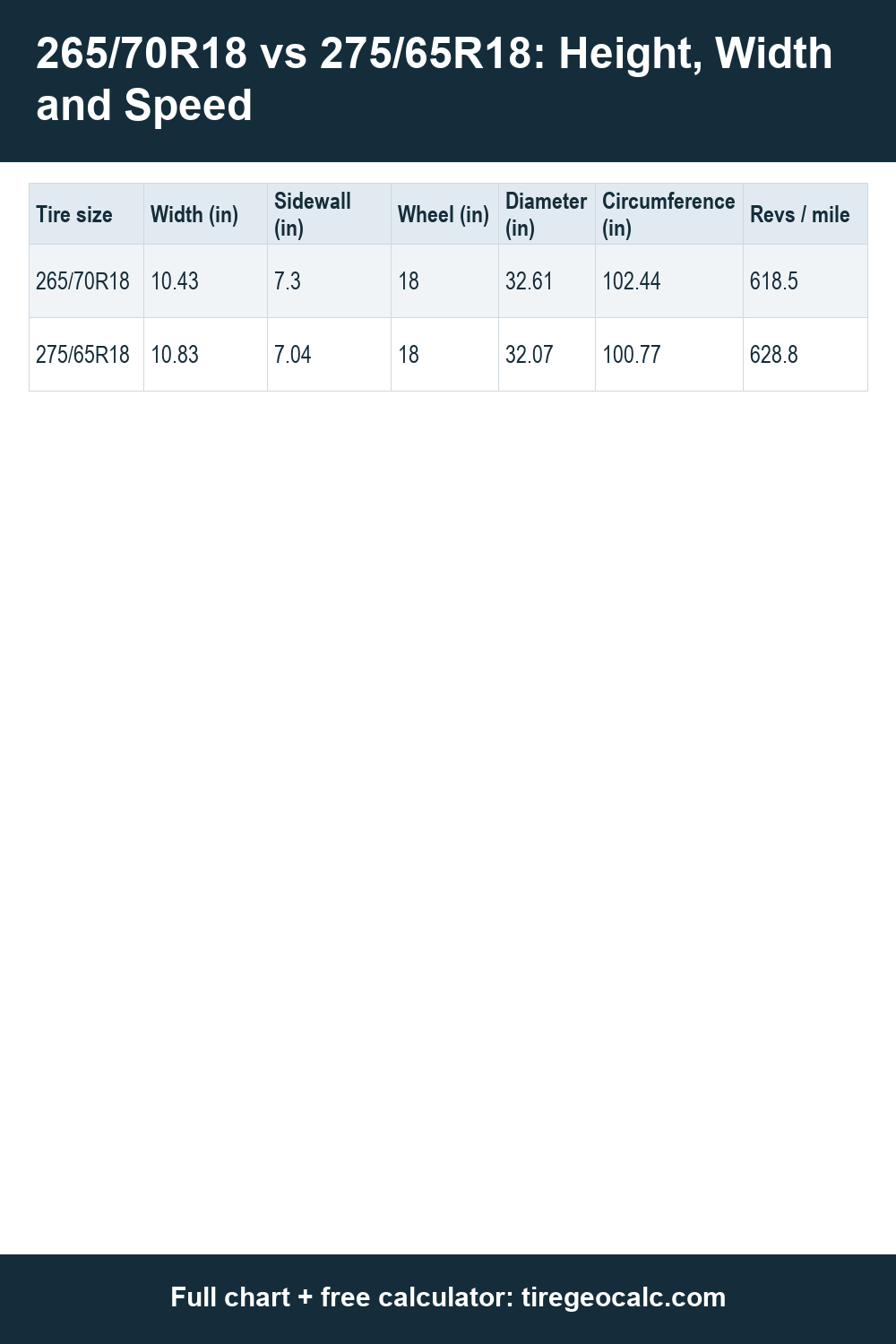
| Tire size | Width (mm) | Width (in) | Sidewall (mm) | Sidewall (in) | Wheel (mm) | Wheel (in) | Diameter (mm) | Diameter (in) | Circumference (mm) | Circumference (in) | Revolutions / mile | Revolutions / km | Diameter change (%) | Actual at indicated 30 mph | Actual at indicated 60 mph | Actual at indicated 75 mph | Actual minus indicated at 60 mph |
|---|---|---|---|---|---|---|---|---|---|---|---|---|---|---|---|---|---|
| 265/70R18 | 265 | 10.43 | 185.5 | 7.3 | 457.2 | 18 | 828.2 | 32.61 | 2601.9 | 102.44 | 618.5 | 384.3 | 0 | 30 | 60 | 75 | 0 |
| 275/65R18 | 275 | 10.83 | 178.8 | 7.04 | 457.2 | 18 | 814.7 | 32.07 | 2559.5 | 100.77 | 628.8 | 390.7 | -1.63 | 29.5 | 59 | 73.8 | -1 |
Nominal size-code geometry. Reference: 265/70R18. Display rounding only; not fitment approval.
- Tire size
- 265/70R18
- Width (mm)
- 265
- Width (in)
- 10.43
- Sidewall (mm)
- 185.5
- Sidewall (in)
- 7.3
- Wheel (mm)
- 457.2
- Wheel (in)
- 18
- Diameter (mm)
- 828.2
- Diameter (in)
- 32.61
- Circumference (mm)
- 2601.9
- Circumference (in)
- 102.44
- Revolutions / mile
- 618.5
- Revolutions / km
- 384.3
- Diameter change (%)
- 0
- Actual at indicated 30 mph
- 30
- Actual at indicated 60 mph
- 60
- Actual at indicated 75 mph
- 75
- Actual minus indicated at 60 mph
- 0
- Tire size
- 275/65R18
- Width (mm)
- 275
- Width (in)
- 10.83
- Sidewall (mm)
- 178.8
- Sidewall (in)
- 7.04
- Wheel (mm)
- 457.2
- Wheel (in)
- 18
- Diameter (mm)
- 814.7
- Diameter (in)
- 32.07
- Circumference (mm)
- 2559.5
- Circumference (in)
- 100.77
- Revolutions / mile
- 628.8
- Revolutions / km
- 390.7
- Diameter change (%)
- -1.63
- Actual at indicated 30 mph
- 29.5
- Actual at indicated 60 mph
- 59
- Actual at indicated 75 mph
- 73.8
- Actual minus indicated at 60 mph
- -1
A wider truck tire that gives up sidewall percentage
The defining feature of this pair is that width rises while sidewall percentage falls. Those are competing inputs in the sidewall calculation. Do not describe the second marking as a simple upsize before reading the diameter result. A broader section can occupy more lateral space while requiring less space above the axle. The two questions need separate answers even though both arise from the same replacement.
For a pickup, a close outside height can make the candidate attractive on paper, but wheel mounting range is still product specific. Check the actual tire model against the existing wheel width. If the wheel changes as well, document offset separately. The nominal section width difference cannot tell you how much of the new assembly moves toward the suspension and how much moves toward the outer arch.
The calculated change from 265/70R18 to 275/65R18
Using 265/70R18 as original, 275/65R18 changes nominal diameter from 32.61 to 32.07 inches. The difference is -13.50 mm, or -1.63% of the original diameter. Nominal section width changes by +10.00 mm and one sidewall changes by -6.75 mm. Those figures are calculated from the complete markings. They describe different dimensions, so a diameter result cannot stand in for a lateral clearance result.
The ideal radius difference is -6.75 mm (-0.27 inches). This is the geometric contribution to wheel center height, not a verified loaded ground clearance change. At an indicated 60 mph, the candidate gives a theoretical 59.02 mph actual speed, or -0.98 mph actual minus indicated. The assumption is calibration to the original circumference with no other instrument error; actual vehicle readings require their own evidence.
What this pair means for the actual assembly
Read the road speed result as a directional calculation from the first tire to the second. An existing instrument may already contain an intentional or measured offset, so the table is not a prediction of its final displayed reading. It isolates the circumference component. If the vehicle was previously recalibrated, establish that reference before applying another ratio; applying the same adjustment twice creates a new error.
If the objective is trail clearance, compare the ideal radius change with the width consequences rather than treating a broader stance as more ground clearance. A wider tire can make steering or articulation space more demanding without adding height. Verify the exact assembly through movement and retain construction and load requirements. The geometry can identify the dimensional trade, while the vehicle assessment must resolve its practical significance.
Keep circumference, calibration and mounting separate
Circumference is calculated from diameter, and the candidate to original circumference ratio gives the theoretical actual speed multiplier. A taller circle travels farther per revolution, while a shorter one travels less. Reversing original and candidate changes the percentage denominator. Do not reverse this comparison by simply changing the sign of a rounded result; enter the actual original in the calculator and compute the other direction directly.
These calculations describe an ideal circle rather than a loaded rolling test. Exact product dimensions, wear, inflation and load can affect the real assembly. Wheel diameter matching does not establish an approved rim width, offset or vehicle clearance. Keep the actual tire model and complete service markings in the comparison record, and check the vehicle instructions if the dimensional change is outside its specified equipment.
Frequently asked questions
Why is the wider label insufficient to describe this swap?
The sidewall ratio also changes. Overall height depends on width multiplied by that ratio, plus the wheel. Width can increase while diameter moves in the other direction, so both columns matter.
Do the speed and radius figures establish real vehicle fitment?
No. They describe nominal geometry under a stated reference assumption. The exact tire and wheel, vehicle specifications and clearance through movement must be assessed separately; loaded dimensions and instrument behavior are not measured here.
What changes if 265/70R18 is the replacement rather than the original?
Reverse the inputs in the calculator. Percentage change uses the original diameter as denominator, and theoretical speed uses candidate circumference divided by original circumference. A reversed comparison therefore needs a fresh calculation rather than only a changed sign on the displayed percentage.
Continue your comparison
These are nominal geometric calculations, not vehicle fitment approval. Check the vehicle manual and exact tire and wheel specifications, including load and speed ratings, approved rim width and clearance; consult the manual for any diameter change exceeding 3%.
Verified against manufacturer data
Published specifications for the named models, checked on the dates below. Differences mean published minus calculated, divided by calculated. These are examples, not specifications for every tire of this size. P, LT and XL designations remain in the source row; matching nominal dimensions does not make their load capacities interchangeable.
| Size / model | Calculated diameter | Published diameter | Difference | Revolutions per mile: calculated / published (difference) | Source / checked |
|---|---|---|---|---|---|
| 275/65R18116T ToyoCelsius II (243940) | 32.07 in | 32.10 in | +0.08% | 628.8 / not recorded in rev/mile | Toyo specifications |
| LT 275/65 R 18123S E General TireGrabber HTS60 (4490700000) | 32.07 in | 32.10 in | +0.08% | 628.8 / 648 (+3.06%) | General Tire specifications |
How we calculate: nominal geometry and measured rolling data can differ. This comparison is not vehicle fitment approval.
Reference tables: Load index chart and Speed rating chart.