 TireGeoCalc
265/35R20 vs 275/35R20: Size and Speed Changes
Quick answer
Nominal geometry265/35R20 → 275/35R20 · original-size calibration assumed
- Diameter difference
- +0.28in
- Diameter change
- +1.01%
- Actual at indicated 60 mph
- 60.61mph
Calculated from size markings. Not measured rolling dimensions or vehicle fitment approval.
Published
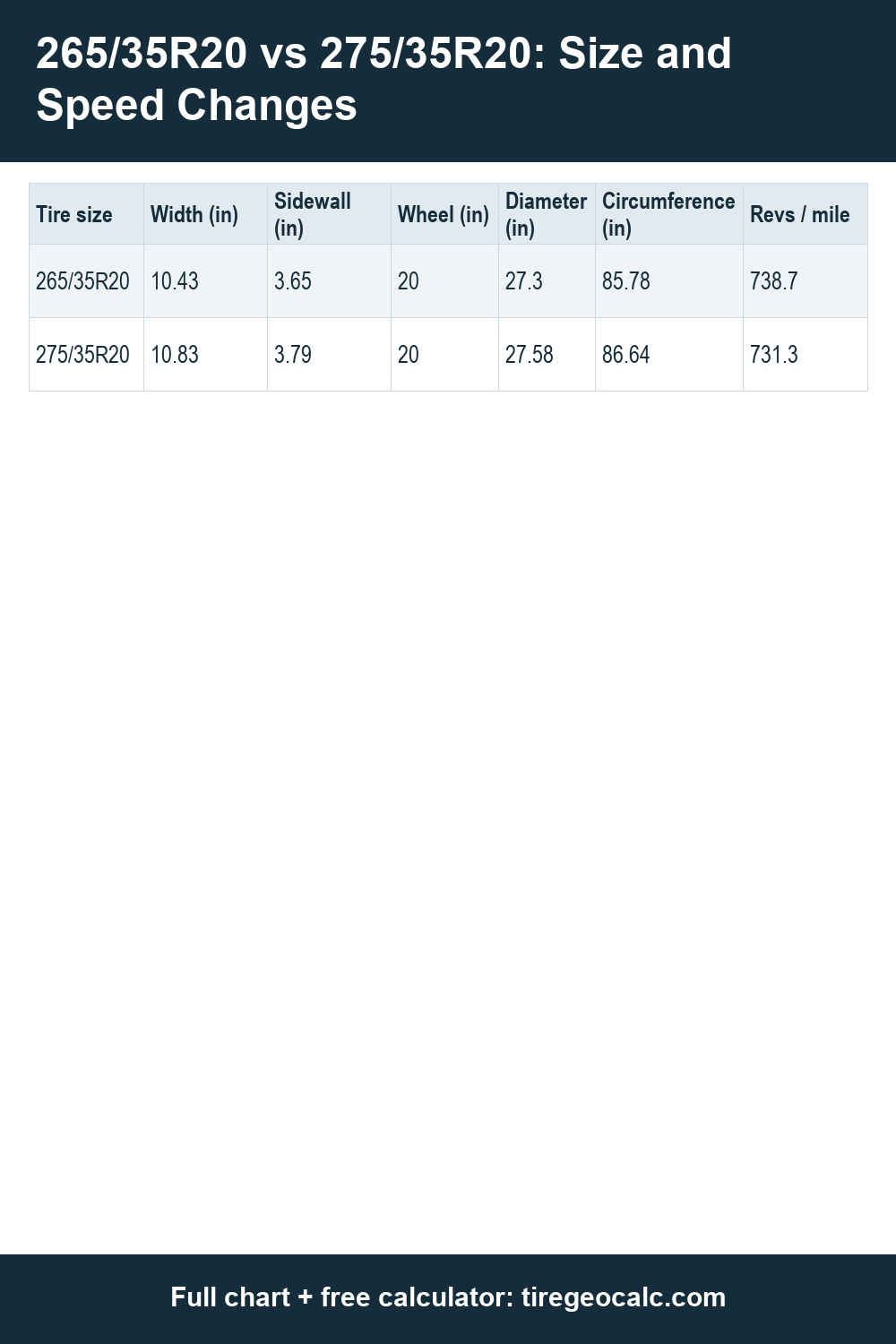
265/35R20 versus 275/35R20 changes nominal width while leaving the wheel and aspect ratio untouched. This makes the pair a clear way to see a low ratio width increase create a small diameter increase. It is especially useful when researching large performance wheel packages with tight lateral space. Read the first size as the original throughout this comparison, including the speed and radius examples below.
Calculated tire dimensions and changes from the original
The first row, 265/35R20, is the original reference. All measurements are derived from the tire geometry engine. Percentages and theoretical speed values keep that same original throughout; rounding is for display only.
| Tire size | Width (mm) | Width (in) | Sidewall (mm) | Sidewall (in) | Wheel (mm) | Wheel (in) | Diameter (mm) | Diameter (in) | Circumference (mm) | Circumference (in) | Revolutions / mile | Revolutions / km | Diameter change (%) | Actual at indicated 30 mph | Actual at indicated 60 mph | Actual at indicated 75 mph | Actual minus indicated at 60 mph |
|---|---|---|---|---|---|---|---|---|---|---|---|---|---|---|---|---|---|
| 265/35R20 | 265 | 10.43 | 92.8 | 3.65 | 508 | 20 | 693.5 | 27.3 | 2178.7 | 85.78 | 738.7 | 459 | 0 | 30 | 60 | 75 | 0 |
| 275/35R20 | 275 | 10.83 | 96.3 | 3.79 | 508 | 20 | 700.5 | 27.58 | 2200.7 | 86.64 | 731.3 | 454.4 | 1.01 | 30.3 | 60.6 | 75.8 | 0.6 |
Nominal size-code geometry. Reference: 265/35R20. Display rounding only; not fitment approval.
- Tire size
- 265/35R20
- Width (mm)
- 265
- Width (in)
- 10.43
- Sidewall (mm)
- 92.8
- Sidewall (in)
- 3.65
- Wheel (mm)
- 508
- Wheel (in)
- 20
- Diameter (mm)
- 693.5
- Diameter (in)
- 27.3
- Circumference (mm)
- 2178.7
- Circumference (in)
- 85.78
- Revolutions / mile
- 738.7
- Revolutions / km
- 459
- Diameter change (%)
- 0
- Actual at indicated 30 mph
- 30
- Actual at indicated 60 mph
- 60
- Actual at indicated 75 mph
- 75
- Actual minus indicated at 60 mph
- 0
- Tire size
- 275/35R20
- Width (mm)
- 275
- Width (in)
- 10.83
- Sidewall (mm)
- 96.3
- Sidewall (in)
- 3.79
- Wheel (mm)
- 508
- Wheel (in)
- 20
- Diameter (mm)
- 700.5
- Diameter (in)
- 27.58
- Circumference (mm)
- 2200.7
- Circumference (in)
- 86.64
- Revolutions / mile
- 731.3
- Revolutions / km
- 454.4
- Diameter change (%)
- 1.01
- Actual at indicated 30 mph
- 30.3
- Actual at indicated 60 mph
- 60.6
- Actual at indicated 75 mph
- 75.8
- Actual minus indicated at 60 mph
- 0.6
A broad twenty inch width comparison without a wheel swap
The twenty inch wheel is common to both rows, so it cancels out of the diameter difference. Only the two proportional sidewalls explain the height change. That makes the arithmetic simple, but it does not make the actual installation simple: tire shape, wheel width and offset still control the occupied space around the assembly.
The wider candidate has a slightly longer ideal circumference and fewer geometric revolutions per mile. With original calibration left unchanged, its theoretical actual speed is slightly higher than indicated. These are different presentations of one size ratio, not three independent pieces of evidence that the tire will work on a vehicle.
Speed, radius and wheel position in this pair
The key ratio in 265/35R20 versus 275/35R20 is 700.50 divided by 693.50, using millimeters for both diameters. That produces +1.01% change in ideal travel for each counted wheel revolution. Under unchanged original calibration, indicated 60 mph becomes theoretical 60.61 mph, with a signed difference of +0.61 mph. For a slower 30 mph indication the model gives 30.30 mph. Actual rolling measurements and the vehicle's existing instrument behavior are not inputs to those results.
For the large performance wheel package, the difference between 265/35R20 and 275/35R20 is not confined to width. The wider sidewall grows from 92.75 to 96.25 mm, raising complete height by 7.00 mm and ideal radius by 3.50 mm. Both bead seats remain twenty inches. The direction matters if a seller calls the sizes equivalent: near circumference says nothing about whether a particular broader tire has room on the intended wheel beside suspension hardware. The original remains the geometric reference, and a reason to choose the candidate must be supported by the product and application details that this nominal table does not contain.
Put the dimensional result in context
If a seller presents the two sizes as equivalent, ask what definition of equivalent is intended. Near overall height may be enough for an initial geometric comparison, while wheel approval, carrying requirements and clearance remain unanswered. Keep those conditions explicit in the record. This helps prevent a useful dimensional observation from becoming an unsupported fitment promise.
Frequently asked questions
Why should I ask a seller what equivalent means for this pair?
A seller comparing 265/35R20 with 275/35R20 may mean only that their outside diameters are close. An owner might instead need matching service requirements, wheel approval and space beside the suspension. Ask which of those claims the seller can document before considering the candidate. Retaining the original keeps the starting geometry, whereas the wider option adds both section and a little height. The shared twenty inch bead seat narrows one mounting question, but it does not establish equivalent complete assemblies or predict the behavior of either product.
Why retain unrounded values when calculating travel for 265/35R20?
The displayed 27.30 inch height is rounded, while the geometric circumference uses the full 693.50 mm diameter. That yields 85.78 inches per turn and 738.67 revolutions per mile. Recalculating from a rounded cell can differ slightly; keep the definition and precision clear when comparing the result with another dimension source.
Does a longer circumference give three independent reasons to choose the candidate?
Higher theoretical speed, fewer revolutions per mile and longer ideal circumference are related expressions of the same diameter change. They are not separate tests of the wider performance tire. Use the dimensional result once, then obtain the missing wheel approval, service and clearance evidence rather than counting equivalent geometric observations as multiple endorsements.
Continue your comparison
These are nominal geometric calculations, not vehicle fitment approval. Check the vehicle manual and exact tire and wheel specifications, including load and speed ratings, approved rim width and clearance; consult the manual for any diameter change exceeding 3%.
Reference tables: Load index chart and Speed rating chart.