 TireGeoCalc
265/35R20 in Inches: Dimensions and Alternatives
Quick answer
Nominal geometry265/35R20 · nominal size-code geometry
- Overall diameter
- 27.30in
- Section width
- 10.43in
- Sidewall height
- 3.65in
Calculated from size markings. Not measured rolling dimensions or vehicle fitment approval.
Published
265/35R20 is a proportion commonly found on large performance cars; equipment varies by vehicle version and market. 265/35R20 combines a twenty inch bead seat with a broad passenger tire section. It is a useful format to investigate around large performance car wheel packages. The inch figures help distinguish an impressive wheel diameter from the complete tire height, and the neighboring widths show how a constant aspect ratio still changes diameter.
Calculated tire dimensions and changes from the original
The first row, 265/35R20, is the original reference. All measurements are derived from the tire geometry engine. Percentages and theoretical speed values keep that same original throughout; rounding is for display only.
| Tire size | Width (mm) | Width (in) | Sidewall (mm) | Sidewall (in) | Wheel (mm) | Wheel (in) | Diameter (mm) | Diameter (in) | Circumference (mm) | Circumference (in) | Revolutions / mile | Revolutions / km | Diameter change (%) |
|---|---|---|---|---|---|---|---|---|---|---|---|---|---|
| 265/35R20 | 265 | 10.43 | 92.8 | 3.65 | 508 | 20 | 693.5 | 27.3 | 2178.7 | 85.78 | 738.7 | 459 | 0 |
| 255/35R20 | 255 | 10.04 | 89.3 | 3.51 | 508 | 20 | 686.5 | 27.03 | 2156.7 | 84.91 | 746.2 | 463.7 | -1.01 |
| 275/35R20 | 275 | 10.83 | 96.3 | 3.79 | 508 | 20 | 700.5 | 27.58 | 2200.7 | 86.64 | 731.3 | 454.4 | 1.01 |
Nominal size-code geometry. Reference: 265/35R20. Display rounding only; not fitment approval.
- Tire size
- 265/35R20
- Width (mm)
- 265
- Width (in)
- 10.43
- Sidewall (mm)
- 92.8
- Sidewall (in)
- 3.65
- Wheel (mm)
- 508
- Wheel (in)
- 20
- Diameter (mm)
- 693.5
- Diameter (in)
- 27.3
- Circumference (mm)
- 2178.7
- Circumference (in)
- 85.78
- Revolutions / mile
- 738.7
- Revolutions / km
- 459
- Diameter change (%)
- 0
- Tire size
- 255/35R20
- Width (mm)
- 255
- Width (in)
- 10.04
- Sidewall (mm)
- 89.3
- Sidewall (in)
- 3.51
- Wheel (mm)
- 508
- Wheel (in)
- 20
- Diameter (mm)
- 686.5
- Diameter (in)
- 27.03
- Circumference (mm)
- 2156.7
- Circumference (in)
- 84.91
- Revolutions / mile
- 746.2
- Revolutions / km
- 463.7
- Diameter change (%)
- -1.01
- Tire size
- 275/35R20
- Width (mm)
- 275
- Width (in)
- 10.83
- Sidewall (mm)
- 96.3
- Sidewall (in)
- 3.79
- Wheel (mm)
- 508
- Wheel (in)
- 20
- Diameter (mm)
- 700.5
- Diameter (in)
- 27.58
- Circumference (mm)
- 2200.7
- Circumference (in)
- 86.64
- Revolutions / mile
- 731.3
- Revolutions / km
- 454.4
- Diameter change (%)
- 1.01
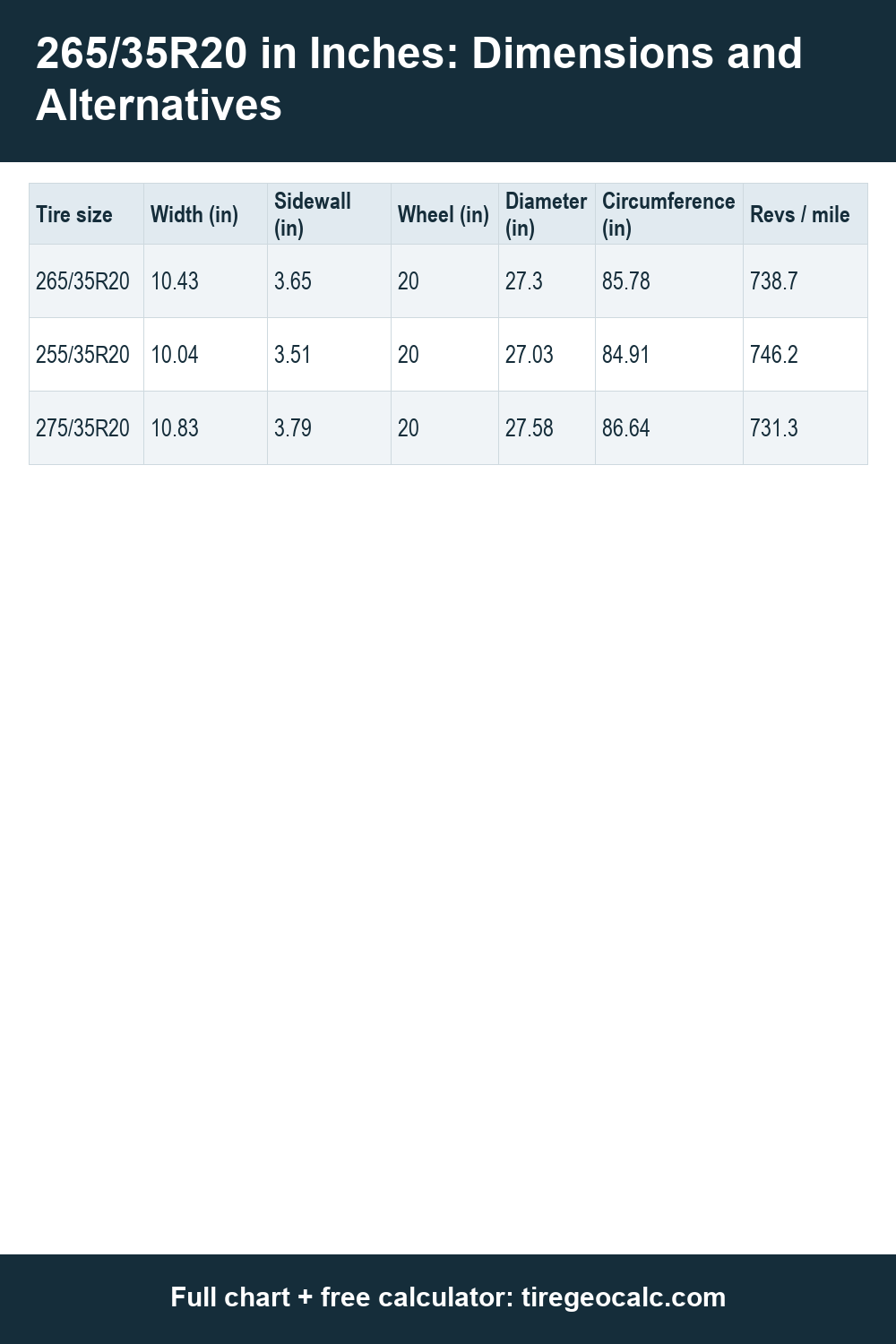
Twenty inch performance packages with two different width neighbors
A twenty inch listing can conceal a surprisingly important difference between tire height and wheel height. The sidewall is calculated from 265 millimeters of nominal width, then added above and below the wheel. That relationship explains why selecting another tire merely because it also ends in R20 does not preserve the same outside dimensions.
The 255/35R20 and 275/35R20 examples form an equal nominal width step on either side of the reference. Their sidewalls change with width because the percentage stays fixed. Use the table as a controlled comparison: wheel diameter is held constant, leaving the section width to explain every difference in nominal outside height. Exact tread width remains a separate product specification.
Dimensions behind this particular shape
Read 265/35R20 from the outside circle inward: a 27.30 inch calculated diameter contains a 20 inch bead seat and two 3.65 inch sidewalls. The section converts to 10.43 inches across, while each sidewall is only 35% of the original 265 mm width. This explains why the last number identifies the wheel rather than the complete height. In millimeters the same assembly adds 185.50 of sidewall to 508.0 of wheel, totaling 693.50.
A large performance wheel can dominate a photograph of 265/35R20, so the flanking widths help expose the rubber contribution. At 89.25 mm per side, 255/35R20 finishes at 686.50 mm overall; at 96.25 mm, 275/35R20 finishes at 700.50 mm. The original 92.75 mm sidewall and 693.50 mm circle sit exactly between those ideal values before display rounding. The twenty inch wheel supplies the same fixed center in every case. This symmetry is useful for understanding a width experiment, but published shoulder shapes and measuring rims are still needed to place a real tire beside suspension parts.
Research the actual wheel and tire
Large wheel packages can be sensitive to the shape of a particular tire's shoulders. A geometric section width does not model that shape or the influence of the approved wheel width. Before treating a few millimeters as available space, collect measured product information and check the assembly in its actual position. A mathematical neighbor helps frame that investigation but cannot complete it.
Frequently asked questions
Why is a 265/35R20 sidewall not the same as every other 35 series?
Here the percentage acts on a broad 265 mm section. The twenty inch wheel remains fixed in the nearby 255/35R20 and 275/35R20 examples, so the changing rubber height explains all of their diameter differences. This is useful when a large performance car owner sees several apparently similar low profile listings. Ask for the full code rather than accepting a listing headed only R20 or 35 series. Neither shortened label tells you the section, outside height or approved wheel width of the actual tire.
How does the outside height of 265/35R20 become a revolutions figure?
Multiplying 27.30 inches of diameter by pi gives 85.78 inches around the circle. One mile divided by that unrounded distance yields 738.67 revolutions. The calculation has no input for tread wear or tire deflection, so it cannot reconstruct the rolling travel of the physical tire currently on the vehicle.
What does a product measuring rim add to the nominal section?
A catalog may state section width on a particular wheel width. Keep that measuring condition with the published value when evaluating this broad twenty inch format. The nominal section in the code is useful for identifying the tire, but it cannot by itself locate the installed shoulder relative to nearby suspension hardware.
Continue your comparison
These are nominal geometric calculations, not vehicle fitment approval. Check the vehicle manual and exact tire and wheel specifications, including load and speed ratings, approved rim width and clearance; consult the manual for any diameter change exceeding 3%.
Reference tables: Load index chart and Speed rating chart.