 TireGeoCalc
255/75R17 vs 265/70R17: Size and Speed Changes
Quick answer
Nominal geometry255/75R17 → 265/70R17 · original-size calibration assumed
- Diameter difference
- -0.45in
- Diameter change
- -1.41%
- Actual at indicated 60 mph
- 59.15mph
Calculated from size markings. Not measured rolling dimensions or vehicle fitment approval.
Published
255/75R17 and 265/70R17 invite comparison because a narrower tall ratio and a wider lower ratio can land near one another in total height. Both use a seventeen inch bead seat. The useful question is how the extra section width trades against sidewall, followed by how that small height change affects the original calibration assumption. Read the first size as the original throughout this comparison, including the speed and radius examples below.
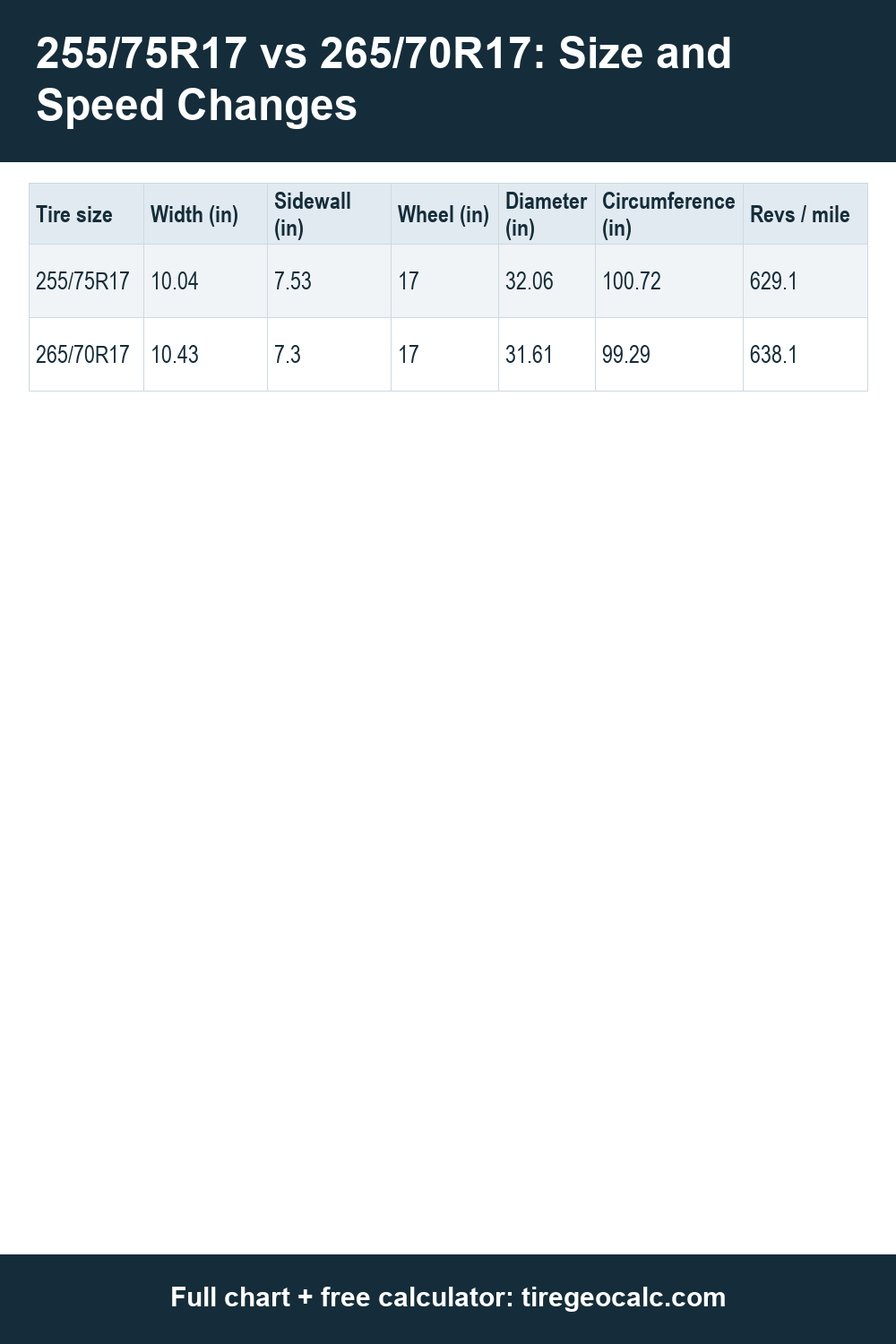
Calculated tire dimensions and changes from the original
The first row, 255/75R17, is the original reference. All measurements are derived from the tire geometry engine. Percentages and theoretical speed values keep that same original throughout; rounding is for display only.
| Tire size | Width (mm) | Width (in) | Sidewall (mm) | Sidewall (in) | Wheel (mm) | Wheel (in) | Diameter (mm) | Diameter (in) | Circumference (mm) | Circumference (in) | Revolutions / mile | Revolutions / km | Diameter change (%) | Actual at indicated 30 mph | Actual at indicated 60 mph | Actual at indicated 75 mph | Actual minus indicated at 60 mph |
|---|---|---|---|---|---|---|---|---|---|---|---|---|---|---|---|---|---|
| 255/75R17 | 255 | 10.04 | 191.3 | 7.53 | 431.8 | 17 | 814.3 | 32.06 | 2558.2 | 100.72 | 629.1 | 390.9 | 0 | 30 | 60 | 75 | 0 |
| 265/70R17 | 265 | 10.43 | 185.5 | 7.3 | 431.8 | 17 | 802.8 | 31.61 | 2522.1 | 99.29 | 638.1 | 396.5 | -1.41 | 29.6 | 59.2 | 73.9 | -0.8 |
Nominal size-code geometry. Reference: 255/75R17. Display rounding only; not fitment approval.
- Tire size
- 255/75R17
- Width (mm)
- 255
- Width (in)
- 10.04
- Sidewall (mm)
- 191.3
- Sidewall (in)
- 7.53
- Wheel (mm)
- 431.8
- Wheel (in)
- 17
- Diameter (mm)
- 814.3
- Diameter (in)
- 32.06
- Circumference (mm)
- 2558.2
- Circumference (in)
- 100.72
- Revolutions / mile
- 629.1
- Revolutions / km
- 390.9
- Diameter change (%)
- 0
- Actual at indicated 30 mph
- 30
- Actual at indicated 60 mph
- 60
- Actual at indicated 75 mph
- 75
- Actual minus indicated at 60 mph
- 0
- Tire size
- 265/70R17
- Width (mm)
- 265
- Width (in)
- 10.43
- Sidewall (mm)
- 185.5
- Sidewall (in)
- 7.3
- Wheel (mm)
- 431.8
- Wheel (in)
- 17
- Diameter (mm)
- 802.8
- Diameter (in)
- 31.61
- Circumference (mm)
- 2522.1
- Circumference (in)
- 99.29
- Revolutions / mile
- 638.1
- Revolutions / km
- 396.5
- Diameter change (%)
- -1.41
- Actual at indicated 30 mph
- 29.6
- Actual at indicated 60 mph
- 59.2
- Actual at indicated 75 mph
- 73.9
- Actual minus indicated at 60 mph
- -0.8
Similar utility tire height with a different width balance
The wider candidate actually calculates shorter. Its lower ratio removes more sidewall than the added width restores. That means a search for a wider footprint does not imply a taller tire in this pair. Nominal section width is also not a measured footprint or tread width, so keep traction claims out of the geometric result.
The small outside height difference can distract from product construction. Utility tire searches may include different service categories or load descriptions in these two codes. Record the full marking and compare exact products. A close diameter does not make a passenger construction and an LT construction equivalent or supply the operating pressure needed for a particular load.
Speed, radius and wheel position in this pair
Starting from 255/75R17, the candidate 265/70R17 has 31.61 inches of calculated height instead of 32.06. Its -11.50 mm diameter change amounts to -1.41% of the original. The speed example follows the same ratio: a 60 mph indication becomes 59.15 mph theoretically, while 75 indicated becomes 73.94 mph. Reversing the original and candidate would change the denominator, so a return to the first size requires a fresh calculation rather than merely reversing a rounded percentage sign.
A width increase from 255 to 265 mm accompanies a sidewall reduction from 191.25 to 185.50 mm in this utility comparison. Consequently the candidate loses 11.50 mm of diameter and 5.75 mm of ideal radius. The original is the taller narrow proportion, while the candidate is broader and lower on the unchanged seventeen inch bead seat. That can be relevant when researching a specified alternative, but it does not support a request for extra under axle height. Product construction and load description should also be preserved in the comparison, rather than treating near outside height as evidence of equivalent truck service.
Put the dimensional result in context
Wheel width remains important even though both codes end in R17. The table does not state the approved rim range of either tire. If retaining the original wheels is part of the plan, confirm the exact pairing before purchasing. Use the diameter result for the speed and radius discussion and use the width result to begin the separate lateral clearance investigation.
Frequently asked questions
Why compare a narrower tall tire with a wider shorter one?
255/75R17 and 265/70R17 put tall narrow utility proportions beside a broader lower ratio. Someone researching an existing seventeen inch wheel may want to understand that trade before selecting exact products. The candidate reduces outside height slightly while adding nominal section width, so a request for more ground clearance would point in the wrong direction. Retaining the original preserves the reference circle; considering the candidate requires a reason for its altered proportions plus wheel and service checks. Compare construction as well, since a common wheel diameter does not define a common load specification.
What nominal travel does one turn of 255/75R17 represent?
Its 814.30 mm circle gives 100.72 inches of calculated circumference. Dividing one mile by that travel gives 629.09 geometric revolutions. This refers to the ideal outside circle; a catalog rolling value under specified conditions is a different quantity and should retain its own measurement definition when you compare products.
Does similar height establish the same utility tire service category?
A tall narrow original and a slightly lower wider candidate can have close outside dimensions without equivalent product requirements. Compare the complete markings and construction of the actual tires. Matching the seventeen inch center does not select a load rating or provide the pressure guidance needed for the particular loaded utility vehicle.
Continue your comparison
These are nominal geometric calculations, not vehicle fitment approval. Check the vehicle manual and exact tire and wheel specifications, including load and speed ratings, approved rim width and clearance; consult the manual for any diameter change exceeding 3%.
Reference tables: Load index chart and Speed rating chart.