 TireGeoCalc
255/50R20 vs 265/50R20: Size and Speed Changes
Quick answer
Nominal geometry255/50R20 → 265/50R20 · original-size calibration assumed
- Diameter difference
- +0.39in
- Diameter change
- +1.31%
- Actual at indicated 60 mph
- 60.79mph
Calculated from size markings. Not measured rolling dimensions or vehicle fitment approval.
Published
The change from 255/50R20 to 265/50R20 keeps a twenty inch wheel and a fifty percent ratio. Its geometry is relevant to crossover and SUV wheel package searches. The candidate is wider, and half of the width increase is added to each nominal sidewall, producing a complete diameter increase as well. Read the first size as the original throughout this comparison, including the speed and radius examples below.
Calculated tire dimensions and changes from the original
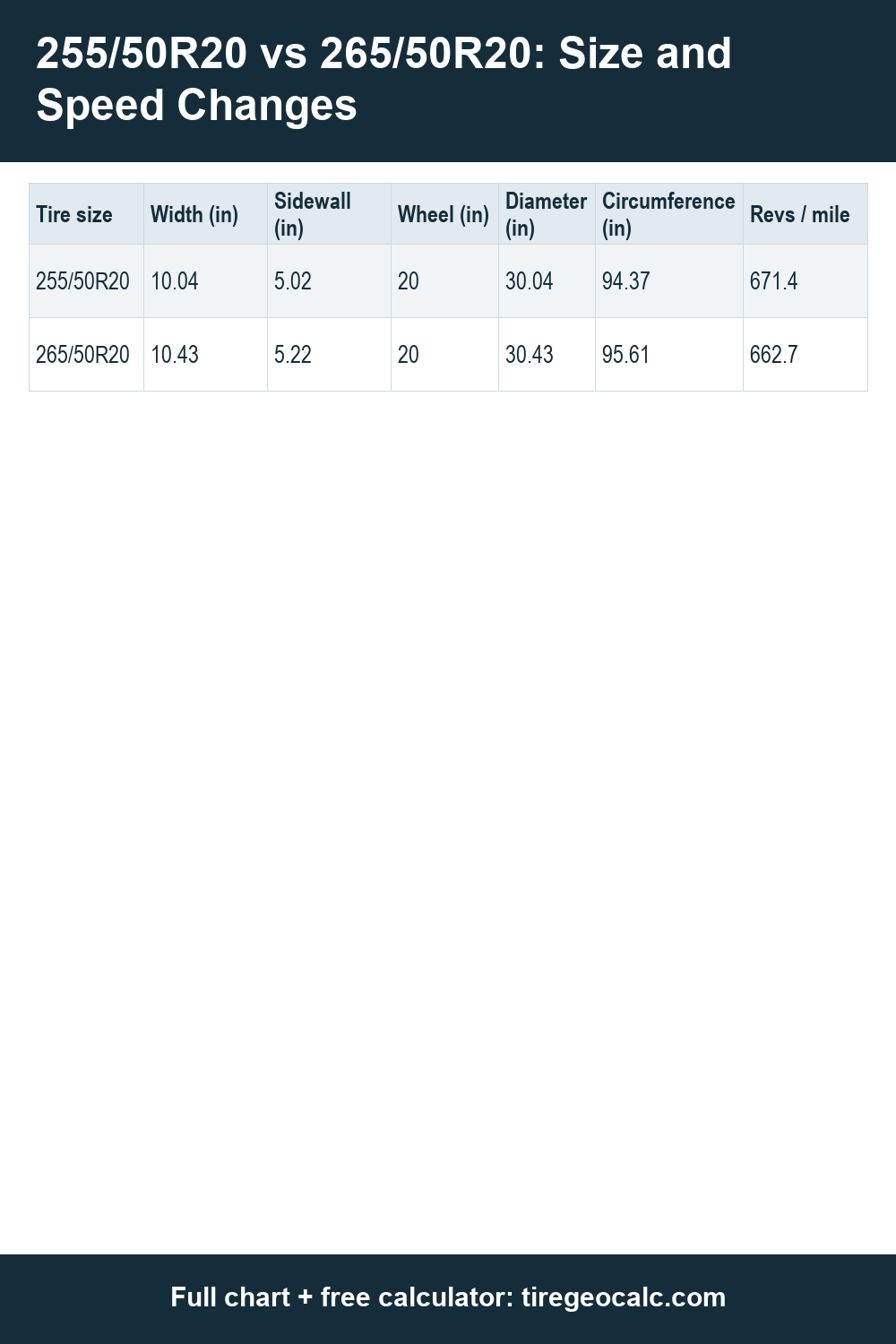
The first row, 255/50R20, is the original reference. All measurements are derived from the tire geometry engine. Percentages and theoretical speed values keep that same original throughout; rounding is for display only.
| Tire size | Width (mm) | Width (in) | Sidewall (mm) | Sidewall (in) | Wheel (mm) | Wheel (in) | Diameter (mm) | Diameter (in) | Circumference (mm) | Circumference (in) | Revolutions / mile | Revolutions / km | Diameter change (%) | Actual at indicated 30 mph | Actual at indicated 60 mph | Actual at indicated 75 mph | Actual minus indicated at 60 mph |
|---|---|---|---|---|---|---|---|---|---|---|---|---|---|---|---|---|---|
| 255/50R20 | 255 | 10.04 | 127.5 | 5.02 | 508 | 20 | 763 | 30.04 | 2397 | 94.37 | 671.4 | 417.2 | 0 | 30 | 60 | 75 | 0 |
| 265/50R20 | 265 | 10.43 | 132.5 | 5.22 | 508 | 20 | 773 | 30.43 | 2428.5 | 95.61 | 662.7 | 411.8 | 1.31 | 30.4 | 60.8 | 76 | 0.8 |
Nominal size-code geometry. Reference: 255/50R20. Display rounding only; not fitment approval.
- Tire size
- 255/50R20
- Width (mm)
- 255
- Width (in)
- 10.04
- Sidewall (mm)
- 127.5
- Sidewall (in)
- 5.02
- Wheel (mm)
- 508
- Wheel (in)
- 20
- Diameter (mm)
- 763
- Diameter (in)
- 30.04
- Circumference (mm)
- 2397
- Circumference (in)
- 94.37
- Revolutions / mile
- 671.4
- Revolutions / km
- 417.2
- Diameter change (%)
- 0
- Actual at indicated 30 mph
- 30
- Actual at indicated 60 mph
- 60
- Actual at indicated 75 mph
- 75
- Actual minus indicated at 60 mph
- 0
- Tire size
- 265/50R20
- Width (mm)
- 265
- Width (in)
- 10.43
- Sidewall (mm)
- 132.5
- Sidewall (in)
- 5.22
- Wheel (mm)
- 508
- Wheel (in)
- 20
- Diameter (mm)
- 773
- Diameter (in)
- 30.43
- Circumference (mm)
- 2428.5
- Circumference (in)
- 95.61
- Revolutions / mile
- 662.7
- Revolutions / km
- 411.8
- Diameter change (%)
- 1.31
- Actual at indicated 30 mph
- 30.4
- Actual at indicated 60 mph
- 60.8
- Actual at indicated 75 mph
- 76
- Actual minus indicated at 60 mph
- 0.8
Twenty inch utility tires with a fixed fifty series proportion
A fifty percent ratio makes the numerical relationship especially easy to follow. The two sidewall gains together equal the nominal section width increase in this particular pair. That coincidence does not mean width and height are generally interchangeable measurements. It follows from this ratio and would change for another aspect ratio.
The larger circumference raises theoretical actual speed under the original calibration assumption and reduces geometric revolutions per mile. If the vehicle has a specific permitted front and rear combination, that small dimensional change still needs to be checked in the full arrangement. This page contains no drivetrain approval or rolling measurement.
Speed, radius and wheel position in this pair
Take the 30.04 inch circle of 255/50R20 as the calibration reference. Substituting the 30.43 inch circle of 265/50R20 changes travel per revolution by +1.31%. An unchanged instrument reading 60 mph would correspond to a modeled 60.79 mph, and a 75 mph reading to 75.98 mph. The candidate diameter differs by +10.00 mm in total. This calculation assumes the original circle defined calibration; a previously changed wheel package or a recalibrated instrument needs its own reference.
The fifty ratio gives this crossover pair a simple dimensional coincidence: ten millimeters more section adds 5.00 mm to each sidewall, totaling 10.00 mm more diameter. Radius rises 5.00 mm, rather than the full diameter increment. The twenty inch wheel contributes no change between the rows. A driver considering a wider documented SUV package can use this arithmetic to separate vertical from lateral questions, but it does not indicate added payload. The candidate's load description, approved wheel and exact dimensions still need checking; the original remains the reference if retaining nominal height is the reason for the selection.
Put the dimensional result in context
Crossovers and SUVs can use different load descriptions within superficially similar wheel packages. Keep the candidate's full service markings and exact tire model with the dimensions. The matching wheel diameter does not certify wheel width or capacity, and the increased nominal tire size does not increase the vehicle's rated capacity. Resolve those requirements from the relevant documentation before purchasing.
Frequently asked questions
Does the wider SUV tire add the same amount to height as to width?
In the particular 255/50R20 to 265/50R20 comparison, the two half width sidewalls together make the diameter increase equal the section increase. That numerical coincidence follows from the fifty ratio. A crossover owner investigating a wider documented wheel option should still separate the new radius from the lateral space used. Retaining the original preserves the starting dimensions; researching the candidate also requires its load description and wheel information. Equal changes in two nominal dimensions do not imply greater payload, a recommended pressure or approval for the existing rim.
Which distance definition accompanies the revolution count for 255/50R20?
The nominal circle covers 94.37 inches per revolution, giving 671.39 turns over a mile. These figures derive from 763.00 mm of outside diameter before rounding. A manufacturer's rolling figure may use specified operating conditions, so keep that product information distinct from the size code calculation instead of mixing the two definitions in one comparison.
Does equal width and diameter growth imply equal capacity growth?
The equal dimension increments arise from the fifty percent ratio, not from a capacity formula. An SUV's payload rating and the tire's carrying specification require their own documentation. A wider candidate on the same twenty inch wheel cannot increase the vehicle rating or supply an operating pressure merely because two nominal dimension changes happen to match.
Continue your comparison
These are nominal geometric calculations, not vehicle fitment approval. Check the vehicle manual and exact tire and wheel specifications, including load and speed ratings, approved rim width and clearance; consult the manual for any diameter change exceeding 3%.
Reference tables: Load index chart and Speed rating chart.