 TireGeoCalc
255/35R19 vs 265/35R19: Size and Speed Changes
Quick answer
Nominal geometry255/35R19 → 265/35R19 · original-size calibration assumed
- Diameter difference
- +0.28in
- Diameter change
- +1.06%
- Actual at indicated 60 mph
- 60.64mph
Calculated from size markings. Not measured rolling dimensions or vehicle fitment approval.
Published
The move from 255/35R19 to 265/35R19 changes only nominal width in the size code. The nineteen inch wheel and thirty five percent ratio stay fixed. Even so, the wider tire has taller sidewalls and a larger outside diameter. This pair separates a small diameter shift from a potentially important lateral fitment question. Read the first size as the original throughout this comparison, including the speed and radius examples below.
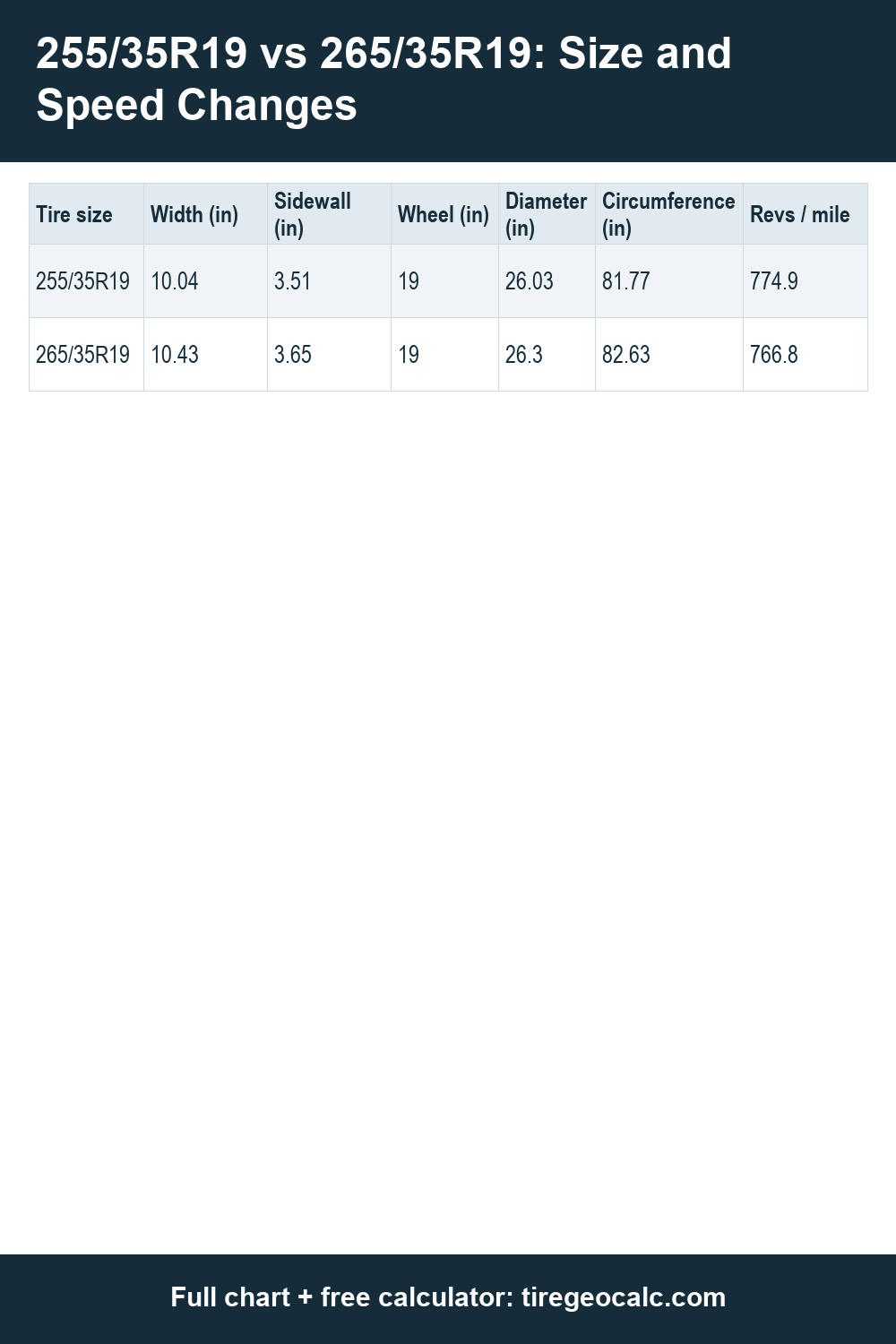
Calculated tire dimensions and changes from the original
The first row, 255/35R19, is the original reference. All measurements are derived from the tire geometry engine. Percentages and theoretical speed values keep that same original throughout; rounding is for display only.
| Tire size | Width (mm) | Width (in) | Sidewall (mm) | Sidewall (in) | Wheel (mm) | Wheel (in) | Diameter (mm) | Diameter (in) | Circumference (mm) | Circumference (in) | Revolutions / mile | Revolutions / km | Diameter change (%) | Actual at indicated 30 mph | Actual at indicated 60 mph | Actual at indicated 75 mph | Actual minus indicated at 60 mph |
|---|---|---|---|---|---|---|---|---|---|---|---|---|---|---|---|---|---|
| 255/35R19 | 255 | 10.04 | 89.3 | 3.51 | 482.6 | 19 | 661.1 | 26.03 | 2076.9 | 81.77 | 774.9 | 481.5 | 0 | 30 | 60 | 75 | 0 |
| 265/35R19 | 265 | 10.43 | 92.8 | 3.65 | 482.6 | 19 | 668.1 | 26.3 | 2098.9 | 82.63 | 766.8 | 476.4 | 1.06 | 30.3 | 60.6 | 75.8 | 0.6 |
Nominal size-code geometry. Reference: 255/35R19. Display rounding only; not fitment approval.
- Tire size
- 255/35R19
- Width (mm)
- 255
- Width (in)
- 10.04
- Sidewall (mm)
- 89.3
- Sidewall (in)
- 3.51
- Wheel (mm)
- 482.6
- Wheel (in)
- 19
- Diameter (mm)
- 661.1
- Diameter (in)
- 26.03
- Circumference (mm)
- 2076.9
- Circumference (in)
- 81.77
- Revolutions / mile
- 774.9
- Revolutions / km
- 481.5
- Diameter change (%)
- 0
- Actual at indicated 30 mph
- 30
- Actual at indicated 60 mph
- 60
- Actual at indicated 75 mph
- 75
- Actual minus indicated at 60 mph
- 0
- Tire size
- 265/35R19
- Width (mm)
- 265
- Width (in)
- 10.43
- Sidewall (mm)
- 92.8
- Sidewall (in)
- 3.65
- Wheel (mm)
- 482.6
- Wheel (in)
- 19
- Diameter (mm)
- 668.1
- Diameter (in)
- 26.3
- Circumference (mm)
- 2098.9
- Circumference (in)
- 82.63
- Revolutions / mile
- 766.8
- Revolutions / km
- 476.4
- Diameter change (%)
- 1.06
- Actual at indicated 30 mph
- 30.3
- Actual at indicated 60 mph
- 60.6
- Actual at indicated 75 mph
- 75.8
- Actual minus indicated at 60 mph
- 0.6
A performance width step with a small simultaneous height gain
At a low aspect ratio, a width step creates less sidewall growth than it would at a tall utility tire ratio. That makes the outside diameter change look modest. The width difference is still present, and its practical effect depends on the exact product shape and wheel. Do not let the small speed change stand in for a clearance assessment.
If this is a rear axle candidate in a performance car, compare the vehicle's allowed front and rear combination rather than one isolated rear tire. The nominal table does not know the existing front size or any drivetrain requirements. Keep the axle position and complete service markings in the record before deciding whether the candidate belongs on the shortlist.
Speed, radius and wheel position in this pair
The key ratio in 255/35R19 versus 265/35R19 is 668.10 divided by 661.10, using millimeters for both diameters. That produces +1.06% change in ideal travel for each counted wheel revolution. Under unchanged original calibration, indicated 60 mph becomes theoretical 60.64 mph, with a signed difference of +0.64 mph. For a slower 30 mph indication the model gives 30.32 mph. Actual rolling measurements and the vehicle's existing instrument behavior are not inputs to those results.
A coupe owner considering the 265 mm candidate should distinguish its ten millimeter section increase from the 7.00 mm outside height increase. The common thirty five ratio adds 3.50 mm per sidewall, and the nineteen inch wheel contributes nothing to the difference. Ideal rear radius rises 3.50 mm if the candidate replaces the original at the rear. That height change may be small, but a specified front and rear relationship still needs reviewing as a combination. The existing wheel's approved tire range and the exact candidate's shoulder dimensions remain necessary before interpreting close diameter as interchangeable rear equipment.
Put the dimensional result in context
Both tires require a nineteen inch bead seat, but their product specific rim ranges may need separate checks. The same wheel number does not establish the same wheel approval. Obtain the candidate's measured dimensions on the appropriate measuring rim, especially when the original assembly already sits close to nearby suspension or bodywork.
Frequently asked questions
Would this width step preserve a staggered coupe arrangement?
255/35R19 to 265/35R19 keeps the bead seat but adds circumference at the rear if that is where the change is made. A coupe owner might investigate the extra width for a documented wheel option, yet the front tire relationship must remain part of that investigation. Keeping the original preserves the reference dimensions; selecting the candidate needs evidence for the complete permitted combination. Neither a small diameter percentage nor a shared nineteen inch wheel size establishes drivetrain suitability, rim approval or room beside the suspension.
Is the circumference for 255/35R19 measured on a loaded car?
No loaded measurement enters this result: 2076.91 mm follows mathematically from the size code diameter. It corresponds to 774.88 ideal revolutions per mile. If your question concerns a particular tire under load, preserve the actual product and test conditions rather than treating this nominal circumference as an observed rolling distance.
Does the small rear radius gain establish drivetrain suitability?
A modest circumference change on one rear axle still changes its relationship with the front. The table cannot see that front specification or the vehicle's permitted combinations. A coupe owner needs the complete documented arrangement before selecting a wider nineteen inch rear tire, regardless of how close the isolated diameter percentage appears.
Continue your comparison
These are nominal geometric calculations, not vehicle fitment approval. Check the vehicle manual and exact tire and wheel specifications, including load and speed ratings, approved rim width and clearance; consult the manual for any diameter change exceeding 3%.
Reference tables: Load index chart and Speed rating chart.