 TireGeoCalc
235/70R16 vs 245/70R16: Size and Speed Changes
Quick answer
Nominal geometry235/70R16 → 245/70R16 · original-size calibration assumed
- Diameter difference
- +0.55in
- Diameter change
- +1.90%
- Actual at indicated 60 mph
- 61.14mph
Calculated from size markings. Not measured rolling dimensions or vehicle fitment approval.
Published
235/70R16 versus 245/70R16 is a controlled comparison: wheel diameter and aspect ratio stay fixed while nominal width increases. The wider candidate must also gain sidewall height because seventy percent is applied to a larger number. It is therefore both wider and taller in the nominal model. Read the first size as the original throughout this comparison, including the speed and radius examples below.
Calculated tire dimensions and changes from the original
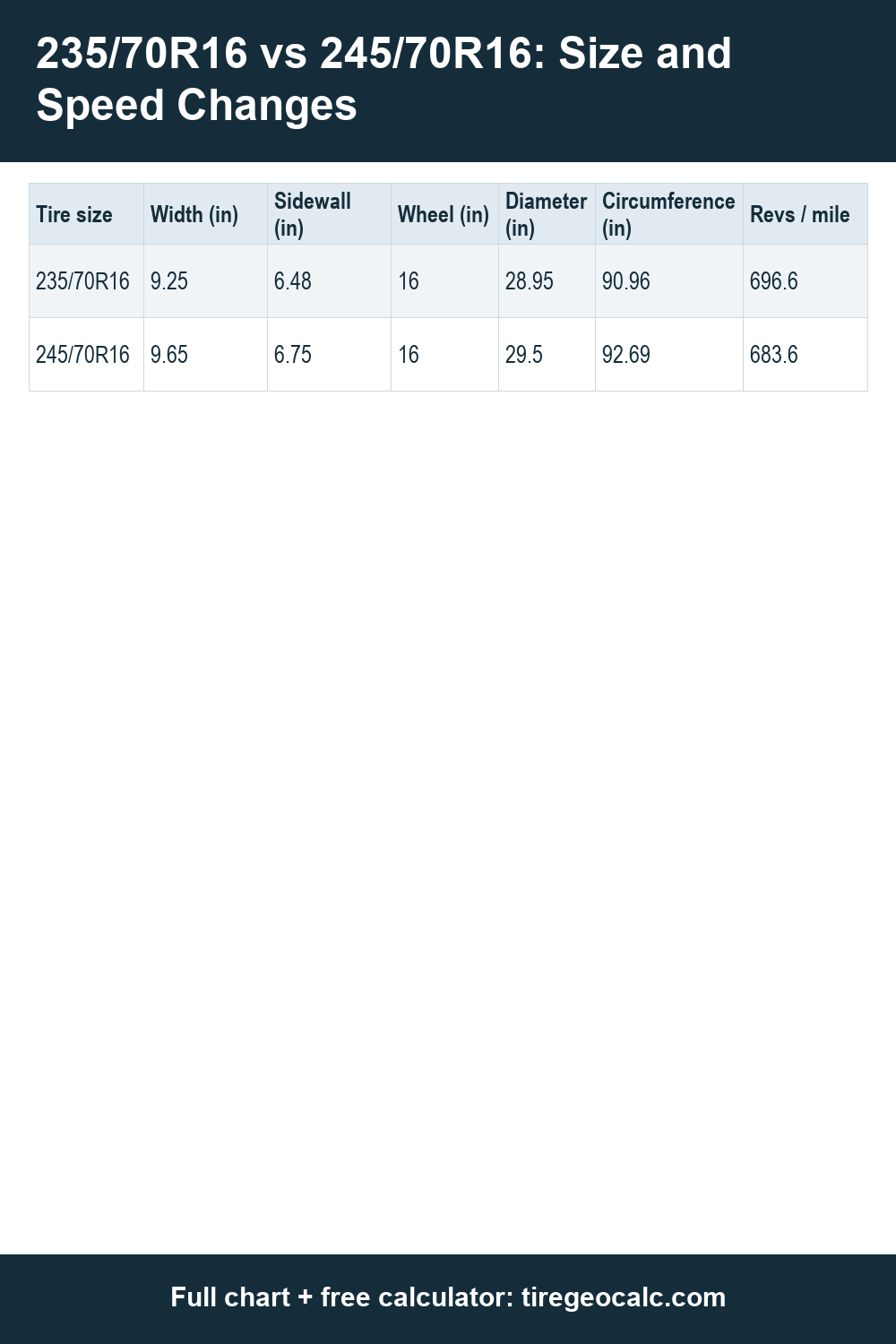
The first row, 235/70R16, is the original reference. All measurements are derived from the tire geometry engine. Percentages and theoretical speed values keep that same original throughout; rounding is for display only.
| Tire size | Width (mm) | Width (in) | Sidewall (mm) | Sidewall (in) | Wheel (mm) | Wheel (in) | Diameter (mm) | Diameter (in) | Circumference (mm) | Circumference (in) | Revolutions / mile | Revolutions / km | Diameter change (%) | Actual at indicated 30 mph | Actual at indicated 60 mph | Actual at indicated 75 mph | Actual minus indicated at 60 mph |
|---|---|---|---|---|---|---|---|---|---|---|---|---|---|---|---|---|---|
| 235/70R16 | 235 | 9.25 | 164.5 | 6.48 | 406.4 | 16 | 735.4 | 28.95 | 2310.3 | 90.96 | 696.6 | 432.8 | 0 | 30 | 60 | 75 | 0 |
| 245/70R16 | 245 | 9.65 | 171.5 | 6.75 | 406.4 | 16 | 749.4 | 29.5 | 2354.3 | 92.69 | 683.6 | 424.8 | 1.9 | 30.6 | 61.1 | 76.4 | 1.1 |
Nominal size-code geometry. Reference: 235/70R16. Display rounding only; not fitment approval.
- Tire size
- 235/70R16
- Width (mm)
- 235
- Width (in)
- 9.25
- Sidewall (mm)
- 164.5
- Sidewall (in)
- 6.48
- Wheel (mm)
- 406.4
- Wheel (in)
- 16
- Diameter (mm)
- 735.4
- Diameter (in)
- 28.95
- Circumference (mm)
- 2310.3
- Circumference (in)
- 90.96
- Revolutions / mile
- 696.6
- Revolutions / km
- 432.8
- Diameter change (%)
- 0
- Actual at indicated 30 mph
- 30
- Actual at indicated 60 mph
- 60
- Actual at indicated 75 mph
- 75
- Actual minus indicated at 60 mph
- 0
- Tire size
- 245/70R16
- Width (mm)
- 245
- Width (in)
- 9.65
- Sidewall (mm)
- 171.5
- Sidewall (in)
- 6.75
- Wheel (mm)
- 406.4
- Wheel (in)
- 16
- Diameter (mm)
- 749.4
- Diameter (in)
- 29.5
- Circumference (mm)
- 2354.3
- Circumference (in)
- 92.69
- Revolutions / mile
- 683.6
- Revolutions / km
- 424.8
- Diameter change (%)
- 1.9
- Actual at indicated 30 mph
- 30.6
- Actual at indicated 60 mph
- 61.1
- Actual at indicated 75 mph
- 76.4
- Actual minus indicated at 60 mph
- 1.1
A same ratio utility tire change that grows in two directions
This pair is useful when a utility vehicle owner describes a candidate as just a little wider. At the same ratio, the two sidewalls add to the outside diameter change. The radius increase is only half of that complete height change. Keeping all three dimensions visible avoids using a width observation as a complete description of the new tire.
Original calibration makes the taller candidate travel farther for each counted revolution. The theoretical actual speed rises above indicated speed and geometric revolutions per mile fall. These are linked consequences of the circumference ratio rather than separate road test findings. An already recalibrated instrument requires its own reference information.
Speed, radius and wheel position in this pair
Take the 28.95 inch circle of 235/70R16 as the calibration reference. Substituting the 29.50 inch circle of 245/70R16 changes travel per revolution by +1.90%. An unchanged instrument reading 60 mph would correspond to a modeled 61.14 mph, and a 75 mph reading to 76.43 mph. The candidate diameter differs by +14.00 mm in total. This calculation assumes the original circle defined calibration; a previously changed wheel package or a recalibrated instrument needs its own reference.
Seventy percent of the ten millimeter width increment adds 7.00 mm to each sidewall here. On the sixteen inch utility wheel, that produces 14.00 mm more diameter and 7.00 mm more ideal radius, with no metal diameter change at all. The taller candidate moves the circle toward the upper wheel opening as it raises the geometric center height. At the same time, section grows from 235 to 245 mm. A request for slightly more width therefore needs both radial and lateral checks, with the actual wheel offset and product shape retained instead of assuming the spare space is shared evenly.
Put the dimensional result in context
Although the bead seat stays at sixteen inches, approval to reuse the wheel still needs exact product data. Check the required rim width and complete service description. A utility vehicle's clearance also depends on wheel position and movement, so a nominal height increase cannot certify space inside the wheel opening. Treat the comparison as a clear statement of changes to assess.
Frequently asked questions
Is the extra width the only clearance change on an older SUV?
Moving from 235/70R16 to 245/70R16 changes height as well as section. A utility vehicle owner may look at the candidate while investigating a documented wider tire option, but the circle also comes closer to the top of the wheel opening. The original remains the reference if preserving its geometry is the priority. At unchanged wheel position the width change suggests examining both shoulders; it does not prove an equal installed shift. Confirm the exact tire dimensions and the actual wheel before assessing the space through steering and suspension movement.
How does the outside height of 235/70R16 become a revolutions figure?
Multiplying 28.95 inches of diameter by pi gives 90.96 inches around the circle. One mile divided by that unrounded distance yields 696.59 revolutions. The calculation has no input for tread wear or tire deflection, so it cannot reconstruct the rolling travel of the physical tire currently on the vehicle.
Can the unchanged sixteen inch bead seat settle rim approval?
A shared wheel diameter establishes where the bead seats in diameter, but does not state an approved wheel width. The wider seventy series product needs its own rim range and service checks. Keep those specifications beside the radius change so an apparently simple utility tire width increase remains a complete application investigation.
Continue your comparison
These are nominal geometric calculations, not vehicle fitment approval. Check the vehicle manual and exact tire and wheel specifications, including load and speed ratings, approved rim width and clearance; consult the manual for any diameter change exceeding 3%.
Reference tables: Load index chart and Speed rating chart.