 TireGeoCalc
235/45R17 vs 245/40R17: Size and Speed Changes
Quick answer
Nominal geometry235/45R17 → 245/40R17 · original-size calibration assumed
- Diameter difference
- -0.61in
- Diameter change
- -2.41%
- Actual at indicated 60 mph
- 58.55mph
Calculated from size markings. Not measured rolling dimensions or vehicle fitment approval.
Published
The candidate 245/40R17 is wider than 235/45R17 but has a lower sidewall percentage. Since the wheel stays at seventeen inches, the sidewall calculation decides the entire height change. This pair is useful for sport sedan research because the width increase and diameter change point in different directions. Read the first size as the original throughout this comparison, including the speed and radius examples below.
Calculated tire dimensions and changes from the original
The first row, 235/45R17, is the original reference. All measurements are derived from the tire geometry engine. Percentages and theoretical speed values keep that same original throughout; rounding is for display only.
| Tire size | Width (mm) | Width (in) | Sidewall (mm) | Sidewall (in) | Wheel (mm) | Wheel (in) | Diameter (mm) | Diameter (in) | Circumference (mm) | Circumference (in) | Revolutions / mile | Revolutions / km | Diameter change (%) | Actual at indicated 30 mph | Actual at indicated 60 mph | Actual at indicated 75 mph | Actual minus indicated at 60 mph |
|---|---|---|---|---|---|---|---|---|---|---|---|---|---|---|---|---|---|
| 235/45R17 | 235 | 9.25 | 105.8 | 4.16 | 431.8 | 17 | 643.3 | 25.33 | 2021 | 79.57 | 796.3 | 494.8 | 0 | 30 | 60 | 75 | 0 |
| 245/40R17 | 245 | 9.65 | 98 | 3.86 | 431.8 | 17 | 627.8 | 24.72 | 1972.3 | 77.65 | 816 | 507 | -2.41 | 29.3 | 58.6 | 73.2 | -1.4 |
Nominal size-code geometry. Reference: 235/45R17. Display rounding only; not fitment approval.
- Tire size
- 235/45R17
- Width (mm)
- 235
- Width (in)
- 9.25
- Sidewall (mm)
- 105.8
- Sidewall (in)
- 4.16
- Wheel (mm)
- 431.8
- Wheel (in)
- 17
- Diameter (mm)
- 643.3
- Diameter (in)
- 25.33
- Circumference (mm)
- 2021
- Circumference (in)
- 79.57
- Revolutions / mile
- 796.3
- Revolutions / km
- 494.8
- Diameter change (%)
- 0
- Actual at indicated 30 mph
- 30
- Actual at indicated 60 mph
- 60
- Actual at indicated 75 mph
- 75
- Actual minus indicated at 60 mph
- 0
- Tire size
- 245/40R17
- Width (mm)
- 245
- Width (in)
- 9.65
- Sidewall (mm)
- 98
- Sidewall (in)
- 3.86
- Wheel (mm)
- 431.8
- Wheel (in)
- 17
- Diameter (mm)
- 627.8
- Diameter (in)
- 24.72
- Circumference (mm)
- 1972.3
- Circumference (in)
- 77.65
- Revolutions / mile
- 816
- Revolutions / km
- 507
- Diameter change (%)
- -2.41
- Actual at indicated 30 mph
- 29.3
- Actual at indicated 60 mph
- 58.6
- Actual at indicated 75 mph
- 73.2
- Actual minus indicated at 60 mph
- -1.4
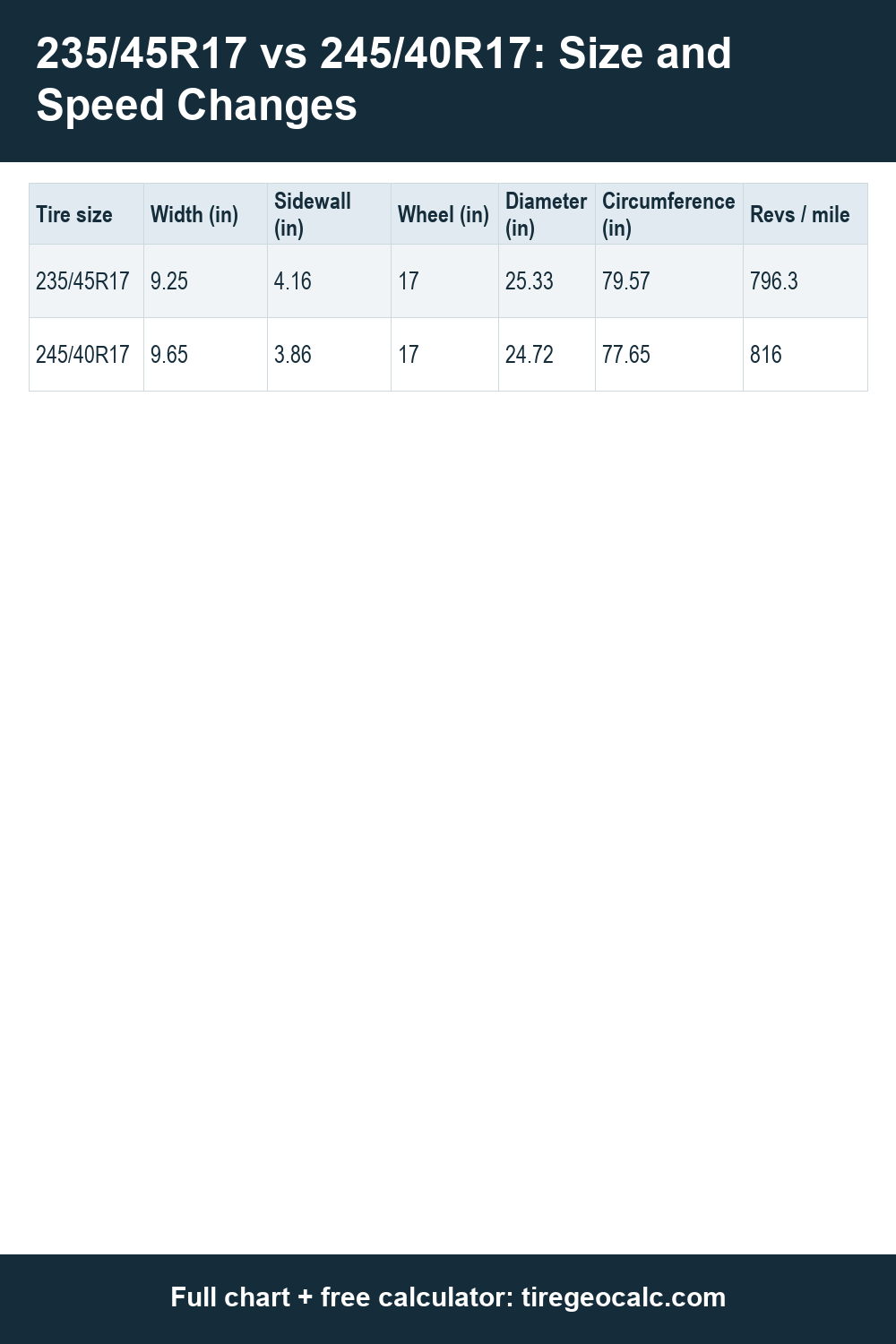
Wider but lower on an unchanged seventeen inch wheel
A forty percent sidewall on the wider candidate is shorter than a forty five percent sidewall on the original. The complete diameter therefore falls while nominal width rises. The ideal radius reduction is half the diameter loss. This describes a lower circle with a broader section, rather than a uniformly smaller or larger tire.
Under the original calibration assumption, the shorter candidate travels less distance per counted revolution. The theoretical actual speed falls below indicated speed and revolutions per mile rise. A reversed comparison needs a new denominator, so do not reuse the same rounded percentage with the sign changed when discussing a return to the original.
Speed, radius and wheel position in this pair
Starting from 235/45R17, the candidate 245/40R17 has 24.72 inches of calculated height instead of 25.33. Its -15.50 mm diameter change amounts to -2.41% of the original. The speed example follows the same ratio: a 60 mph indication becomes 58.55 mph theoretically, while 75 indicated becomes 73.19 mph. Reversing the original and candidate would change the denominator, so a return to the first size requires a fresh calculation rather than merely reversing a rounded percentage sign.
Here the candidate exchanges a 105.75 mm sport sedan sidewall for a lower 98.00 mm one. With the seventeen inch wheel fixed, diameter decreases 15.50 mm and ideal radius decreases 7.75 mm. Width nevertheless increases to 245 mm, so added room above the circle can accompany reduced room alongside it. This is the relevant trade for a driver investigating a lower profile rather than a uniformly smaller assembly. Retaining the original preserves more radius; considering the candidate needs a suitable wheel range and an assessment of the broader section at its actual installed position.
Put the dimensional result in context
Retaining the wheel diameter does not guarantee that the wider candidate is approved for the current rim width. Check exact product requirements and preserve the service description. Lateral clearance can become more restrictive even while a shorter diameter creates more nominal space above the tire. The actual wheel position and tire shape are needed to assess that combination.
Frequently asked questions
Can a shorter sport sedan tire create more side clearance?
245/40R17 is shorter than 235/45R17 but wider in section. An owner researching a lower profile might gain nominal room above the tire while losing room beside it. That is why a single smaller diameter result cannot describe the whole installation. Retaining the original preserves its radius; investigating the candidate calls for a documented wheel pairing and an assessment of both clearance directions. The exact wheel offset and tire shoulder dimensions are necessary to decide where the broader section will sit, even though both codes use a seventeen inch bead seat.
Why retain unrounded values when calculating travel for 235/45R17?
The displayed 25.33 inch height is rounded, while the geometric circumference uses the full 643.30 mm diameter. That yields 79.57 inches per turn and 796.32 revolutions per mile. Recalculating from a rounded cell can differ slightly; keep the definition and precision clear when comparing the result with another dimension source.
Would reversing the comparison preserve the percentage magnitude?
The original diameter supplies the denominator, so returning from the lower wider candidate to the taller original needs a new ratio. Reusing a rounded percentage with its sign changed can introduce a different result. Preserve the order of this sport sedan pair when sharing the nominal speed or diameter calculation with an installer.
Continue your comparison
These are nominal geometric calculations, not vehicle fitment approval. Check the vehicle manual and exact tire and wheel specifications, including load and speed ratings, approved rim width and clearance; consult the manual for any diameter change exceeding 3%.
Verified against manufacturer data
Published specifications for the named models, checked on the dates below. Differences mean published minus calculated, divided by calculated. These are examples, not specifications for every tire of this size. P, LT and XL designations remain in the source row; matching nominal dimensions does not make their load capacities interchangeable.
| Size / model | Calculated diameter | Published diameter | Difference | Revolutions per mile: calculated / published (difference) | Source / checked |
|---|---|---|---|---|---|
| 235/45R1797V ToyoCelsius II (243710) | 25.33 in | 25.40 in | +0.29% | 796.3 / not recorded in rev/mile | Toyo specifications |
| 235/45 R 1797H XL General TireAltiMAX RT45 (15577490000) | 25.33 in | 25.30 in | -0.11% | 796.3 / 820 (+2.97%) | General Tire specifications |
How we calculate: nominal geometry and measured rolling data can differ. This comparison is not vehicle fitment approval.
Reference tables: Load index chart and Speed rating chart.