 TireGeoCalc
225/50R17 vs 235/45R17: Size and Speed Changes
Quick answer
Nominal geometry225/50R17 → 235/45R17 · original-size calibration assumed
- Diameter difference
- -0.53in
- Diameter change
- -2.06%
- Actual at indicated 60 mph
- 58.77mph
Calculated from size markings. Not measured rolling dimensions or vehicle fitment approval.
Published
225/50R17 versus 235/45R17 demonstrates why a wider tire can be shorter. The wheel diameter stays at seventeen inches, so the change comes entirely from the sidewalls. A ten millimeter width increase does not compensate for the lower sidewall percentage. Read the candidate as a different proportion rather than an automatic size upgrade. Read the first size as the original throughout this comparison, including the speed and radius examples below.
Calculated tire dimensions and changes from the original
The first row, 225/50R17, is the original reference. All measurements are derived from the tire geometry engine. Percentages and theoretical speed values keep that same original throughout; rounding is for display only.
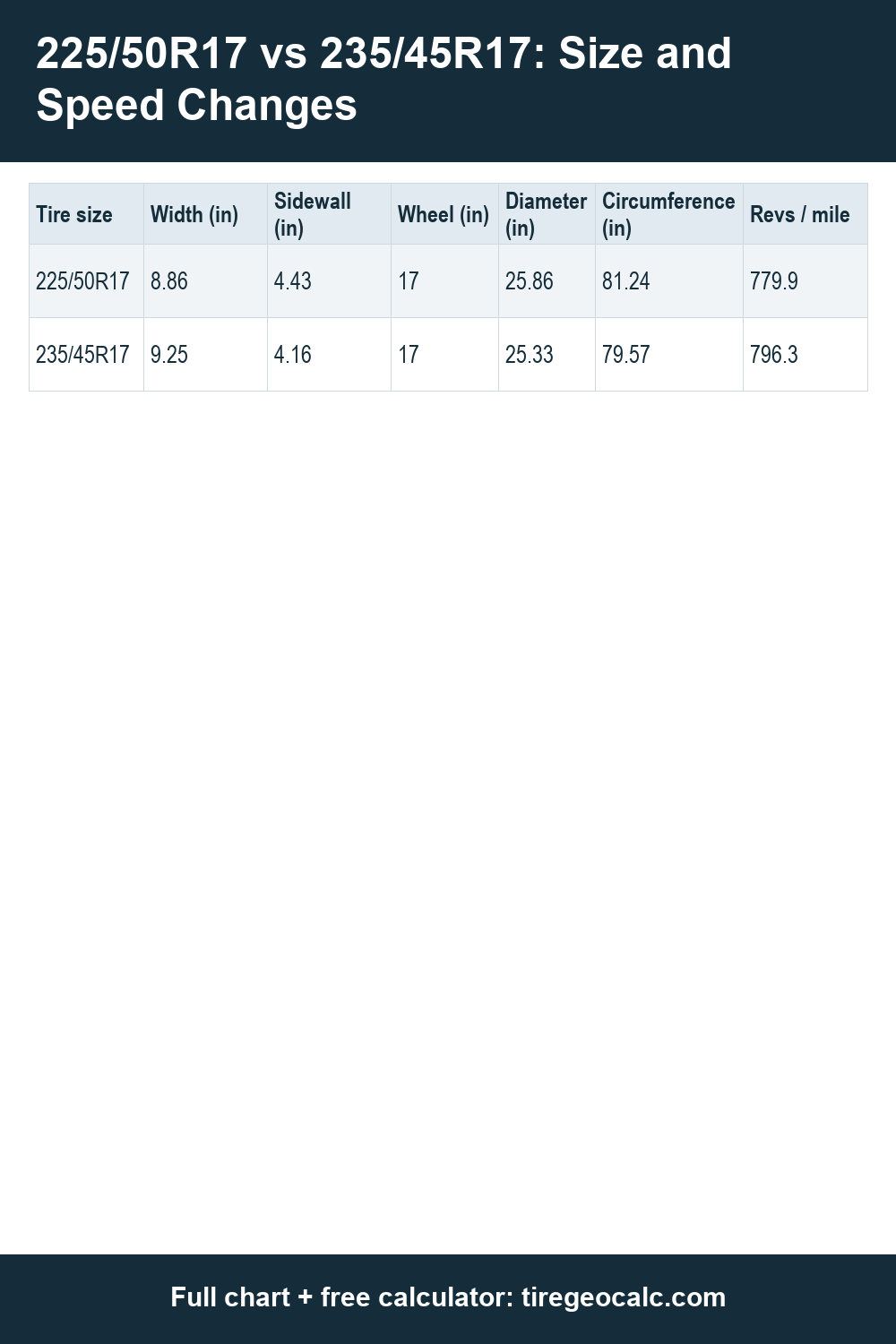
| Tire size | Width (mm) | Width (in) | Sidewall (mm) | Sidewall (in) | Wheel (mm) | Wheel (in) | Diameter (mm) | Diameter (in) | Circumference (mm) | Circumference (in) | Revolutions / mile | Revolutions / km | Diameter change (%) | Actual at indicated 30 mph | Actual at indicated 60 mph | Actual at indicated 75 mph | Actual minus indicated at 60 mph |
|---|---|---|---|---|---|---|---|---|---|---|---|---|---|---|---|---|---|
| 225/50R17 | 225 | 8.86 | 112.5 | 4.43 | 431.8 | 17 | 656.8 | 25.86 | 2063.4 | 81.24 | 779.9 | 484.6 | 0 | 30 | 60 | 75 | 0 |
| 235/45R17 | 235 | 9.25 | 105.8 | 4.16 | 431.8 | 17 | 643.3 | 25.33 | 2021 | 79.57 | 796.3 | 494.8 | -2.06 | 29.4 | 58.8 | 73.5 | -1.2 |
Nominal size-code geometry. Reference: 225/50R17. Display rounding only; not fitment approval.
- Tire size
- 225/50R17
- Width (mm)
- 225
- Width (in)
- 8.86
- Sidewall (mm)
- 112.5
- Sidewall (in)
- 4.43
- Wheel (mm)
- 431.8
- Wheel (in)
- 17
- Diameter (mm)
- 656.8
- Diameter (in)
- 25.86
- Circumference (mm)
- 2063.4
- Circumference (in)
- 81.24
- Revolutions / mile
- 779.9
- Revolutions / km
- 484.6
- Diameter change (%)
- 0
- Actual at indicated 30 mph
- 30
- Actual at indicated 60 mph
- 60
- Actual at indicated 75 mph
- 75
- Actual minus indicated at 60 mph
- 0
- Tire size
- 235/45R17
- Width (mm)
- 235
- Width (in)
- 9.25
- Sidewall (mm)
- 105.8
- Sidewall (in)
- 4.16
- Wheel (mm)
- 431.8
- Wheel (in)
- 17
- Diameter (mm)
- 643.3
- Diameter (in)
- 25.33
- Circumference (mm)
- 2021
- Circumference (in)
- 79.57
- Revolutions / mile
- 796.3
- Revolutions / km
- 494.8
- Diameter change (%)
- -2.06
- Actual at indicated 30 mph
- 29.4
- Actual at indicated 60 mph
- 58.8
- Actual at indicated 75 mph
- 73.5
- Actual minus indicated at 60 mph
- -1.2
A wider candidate that is shorter on the same wheel
The wider candidate loses height because forty five percent of its width is less than fifty percent of the original width. Two shorter sidewalls reduce the complete diameter. The speed calculation therefore moves in the opposite direction from the width: under original calibration, theoretical actual speed falls below the indicated value rather than rising above it.
A shorter nominal radius also lowers the ideal wheel center contribution to ground clearance. It can leave more space above an unloaded circle while providing less ideal clearance beneath a fixed axle component. Those geometric observations still do not measure a real loaded vehicle. Keep vertical and lateral clearance as separate questions when discussing the change with an installer.
Speed, radius and wheel position in this pair
Take the 25.86 inch circle of 225/50R17 as the calibration reference. Substituting the 25.33 inch circle of 235/45R17 changes travel per revolution by -2.06%. An unchanged instrument reading 60 mph would correspond to a modeled 58.77 mph, and a 75 mph reading to 73.46 mph. The candidate diameter differs by -13.50 mm in total. This calculation assumes the original circle defined calibration; a previously changed wheel package or a recalibrated instrument needs its own reference.
In this sedan pair, the wheel stays seventeen inches while the candidate sidewall drops from 112.50 to 105.75 mm. Doubling that loss gives the 13.50 mm diameter reduction and 6.75 mm decrease in ideal radius. The wider 235 mm section may occupy more lateral room even though the circle leaves more nominal space above the tire. Someone investigating a broader lower profile needs both observations, not a general bigger tire label. The original keeps the taller circle; the candidate changes the proportion on the same bead seat, subject to separate rim width and product clearance checks.
Put the dimensional result in context
For a sedan on existing seventeen inch wheels, retaining the bead seat diameter is only one mounting requirement. The candidate may have a different approved rim range or service description. Check the exact product rather than assuming the original wheel accepts every nearby width. This comparison is a dimensional shortlist for that check, not a replacement approval.
Frequently asked questions
Would choosing the wider option fill more of the gap above the tire?
The 235/45R17 candidate is wider than 225/50R17 but its shorter sidewalls reduce the outside circle. In the ideal drawing it leaves more space above the tire, rather than filling that vertical gap. An owner might investigate the candidate for a documented wider wheel package, while retaining the original avoids introducing that diameter change. Neither width alone nor a sportier appearance establishes better behavior. If appearance started the search, write down separately the lateral position wanted and the outside height permitted by the vehicle documentation.
What nominal travel does one turn of 225/50R17 represent?
Its 656.80 mm circle gives 81.24 inches of calculated circumference. Dividing one mile by that travel gives 779.95 geometric revolutions. This refers to the ideal outside circle; a catalog rolling value under specified conditions is a different quantity and should retain its own measurement definition when you compare products.
Which clearance direction can become more restrictive with the lower candidate?
The wider forty five series candidate can bring its shoulders closer to lateral obstructions while its shorter circle leaves more room above. Those changes act in different directions on the same seventeen inch wheel. An installer needs the exact product and wheel position to assess them rather than treating reduced diameter as extra space everywhere.
Continue your comparison
These are nominal geometric calculations, not vehicle fitment approval. Check the vehicle manual and exact tire and wheel specifications, including load and speed ratings, approved rim width and clearance; consult the manual for any diameter change exceeding 3%.
Verified against manufacturer data
Published specifications for the named models, checked on the dates below. Differences mean published minus calculated, divided by calculated. These are examples, not specifications for every tire of this size. P, LT and XL designations remain in the source row; matching nominal dimensions does not make their load capacities interchangeable.
| Size / model | Calculated diameter | Published diameter | Difference | Revolutions per mile: calculated / published (difference) | Source / checked |
|---|---|---|---|---|---|
| 225/50R17XL98V ToyoExtensa A/S II (148160) | 25.86 in | 25.90 in | +0.16% | 779.9 / not recorded in rev/mile | Toyo specifications |
| 225/50 R 1798V XL General TireAltiMAX RT45 (15577450000) | 25.86 in | 25.90 in | +0.16% | 779.9 / 803 (+2.96%) | General Tire specifications |
| 235/45R1797V ToyoCelsius II (243710) | 25.33 in | 25.40 in | +0.29% | 796.3 / not recorded in rev/mile | Toyo specifications |
| 235/45 R 1797H XL General TireAltiMAX RT45 (15577490000) | 25.33 in | 25.30 in | -0.11% | 796.3 / 820 (+2.97%) | General Tire specifications |
How we calculate: nominal geometry and measured rolling data can differ. This comparison is not vehicle fitment approval.
Reference tables: Load index chart and Speed rating chart.