 TireGeoCalc
225/35R19 vs 235/35R19: Size and Speed Changes
Quick answer
Nominal geometry225/35R19 → 235/35R19 · original-size calibration assumed
- Diameter difference
- +0.28in
- Diameter change
- +1.09%
- Actual at indicated 60 mph
- 60.66mph
Calculated from size markings. Not measured rolling dimensions or vehicle fitment approval.
Published
The pair 225/35R19 and 235/35R19 keeps the nineteen inch wheel and low ratio fixed. It is useful for compact performance car research where the proposed change is often described simply as going wider. The sidewalls grow too, so outside diameter and theoretical travel per revolution also change. Read the first size as the original throughout this comparison, including the speed and radius examples below.
Calculated tire dimensions and changes from the original
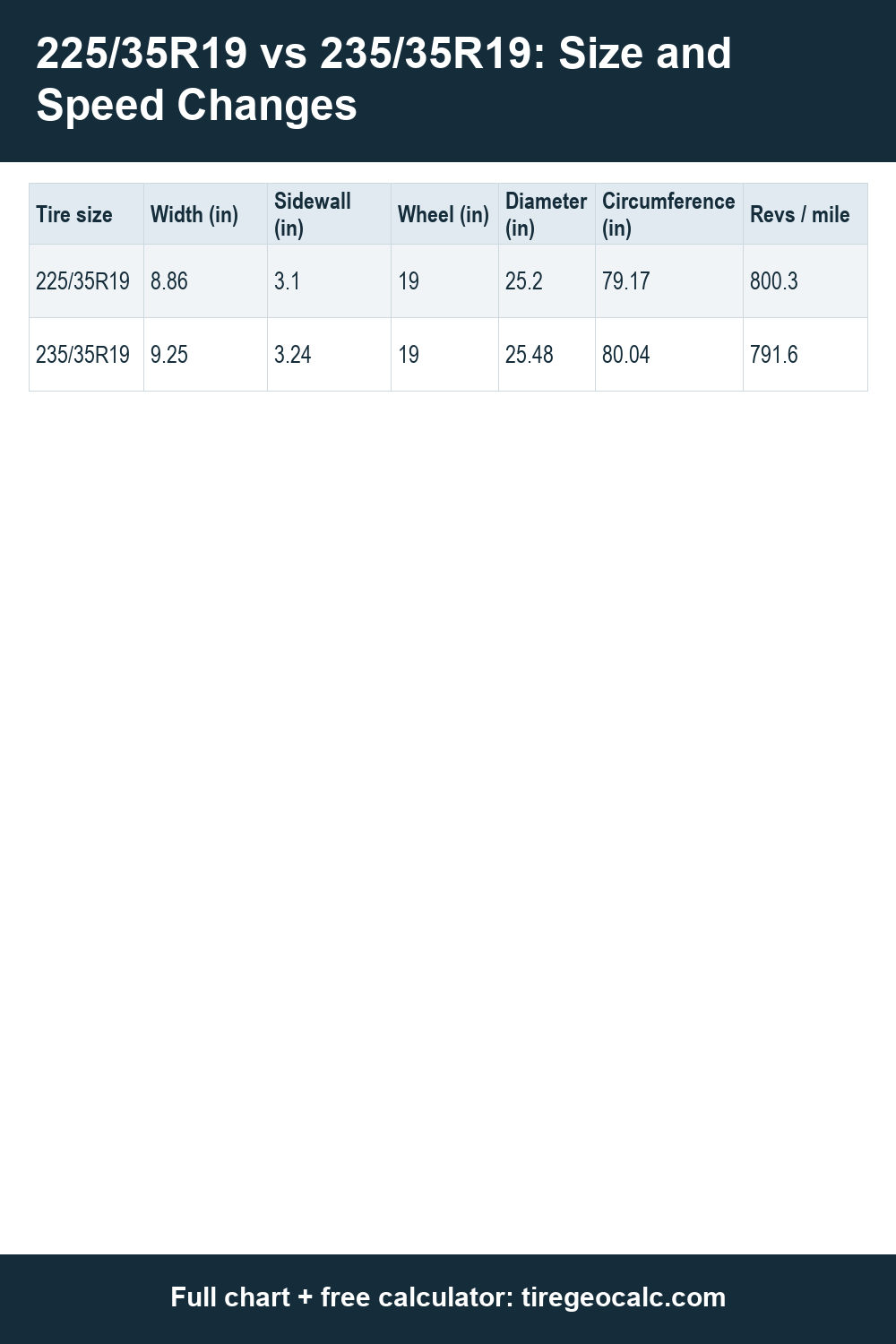
The first row, 225/35R19, is the original reference. All measurements are derived from the tire geometry engine. Percentages and theoretical speed values keep that same original throughout; rounding is for display only.
| Tire size | Width (mm) | Width (in) | Sidewall (mm) | Sidewall (in) | Wheel (mm) | Wheel (in) | Diameter (mm) | Diameter (in) | Circumference (mm) | Circumference (in) | Revolutions / mile | Revolutions / km | Diameter change (%) | Actual at indicated 30 mph | Actual at indicated 60 mph | Actual at indicated 75 mph | Actual minus indicated at 60 mph |
|---|---|---|---|---|---|---|---|---|---|---|---|---|---|---|---|---|---|
| 225/35R19 | 225 | 8.86 | 78.8 | 3.1 | 482.6 | 19 | 640.1 | 25.2 | 2010.9 | 79.17 | 800.3 | 497.3 | 0 | 30 | 60 | 75 | 0 |
| 235/35R19 | 235 | 9.25 | 82.3 | 3.24 | 482.6 | 19 | 647.1 | 25.48 | 2032.9 | 80.04 | 791.6 | 491.9 | 1.09 | 30.3 | 60.7 | 75.8 | 0.7 |
Nominal size-code geometry. Reference: 225/35R19. Display rounding only; not fitment approval.
- Tire size
- 225/35R19
- Width (mm)
- 225
- Width (in)
- 8.86
- Sidewall (mm)
- 78.8
- Sidewall (in)
- 3.1
- Wheel (mm)
- 482.6
- Wheel (in)
- 19
- Diameter (mm)
- 640.1
- Diameter (in)
- 25.2
- Circumference (mm)
- 2010.9
- Circumference (in)
- 79.17
- Revolutions / mile
- 800.3
- Revolutions / km
- 497.3
- Diameter change (%)
- 0
- Actual at indicated 30 mph
- 30
- Actual at indicated 60 mph
- 60
- Actual at indicated 75 mph
- 75
- Actual minus indicated at 60 mph
- 0
- Tire size
- 235/35R19
- Width (mm)
- 235
- Width (in)
- 9.25
- Sidewall (mm)
- 82.3
- Sidewall (in)
- 3.24
- Wheel (mm)
- 482.6
- Wheel (in)
- 19
- Diameter (mm)
- 647.1
- Diameter (in)
- 25.48
- Circumference (mm)
- 2032.9
- Circumference (in)
- 80.04
- Revolutions / mile
- 791.6
- Revolutions / km
- 491.9
- Diameter change (%)
- 1.09
- Actual at indicated 30 mph
- 30.3
- Actual at indicated 60 mph
- 60.7
- Actual at indicated 75 mph
- 75.8
- Actual minus indicated at 60 mph
- 0.7
A compact performance tire width step with low sidewalls
The nominal width difference is easy to see in the codes. The height difference is less obvious until the thirty five percent ratio is applied to each width. The candidate adds only a fraction of the width difference to each sidewall. Combining the two sidewalls gives the complete height change shown in the table.
For a compact hatchback with optional large wheels, preserve the exact factory package information. A candidate with a similar outside height is not automatically approved with the same wheel, and a wheel from another trim may differ in width or offset. Use the chart to describe the tire geometry while checking the wheel package directly.
Speed, radius and wheel position in this pair
Take the 25.20 inch circle of 225/35R19 as the calibration reference. Substituting the 25.48 inch circle of 235/35R19 changes travel per revolution by +1.09%. An unchanged instrument reading 60 mph would correspond to a modeled 60.66 mph, and a 75 mph reading to 75.82 mph. The candidate diameter differs by +7.00 mm in total. This calculation assumes the original circle defined calibration; a previously changed wheel package or a recalibrated instrument needs its own reference.
The compact performance candidate adds ten millimeters of nominal section, but only 3.50 mm to one sidewall. Two such gains make the diameter 7.00 mm larger and the ideal radius 3.50 mm larger. This leaves the nineteen inch wheel unchanged, so bead seat matching is only the beginning of the wheel assessment. A driver might investigate the wider proportion after locating a documented option, while retaining the original keeps its existing circle. The exact rim range and steering clearance are still needed; a small height percentage cannot show what happens beside the shoulder at full lock.
Put the dimensional result in context
Replacing one tire is also a different question from changing a full set. The table cannot establish compatibility with the exact products already installed or their condition. Keep those product and axle questions separate, then use the original size assumption consistently for the speed calculation. A small theoretical change does not settle the broader replacement decision.
Frequently asked questions
Can a compact performance car gain width without any height change here?
The move from 225/35R19 to 235/35R19 produces a height increase because the ratio is applied to the extra width. Someone seeking a documented wider option on a compact performance car should include that change in the shortlist. Staying at the original size avoids treating a small wheel arch gap as permission to increase diameter. The candidate also needs an approved rim range and suitable clearance at steering lock. These checks concern the exact installed tire and wheel, rather than a general promise that a modest nominal percentage is always acceptable.
Why retain unrounded values when calculating travel for 225/35R19?
The displayed 25.20 inch height is rounded, while the geometric circumference uses the full 640.10 mm diameter. That yields 79.17 inches per turn and 800.30 revolutions per mile. Recalculating from a rounded cell can differ slightly; keep the definition and precision clear when comparing the result with another dimension source.
What changes if I am replacing one compact performance tire?
A single replacement also raises questions about the exact products already installed, their condition and their axle relationship. The table compares nominal size codes rather than certifying that a wider new tire matches the remaining set. Keep those existing product details separate from the small height change calculated for the nineteen inch pair.
Continue your comparison
These are nominal geometric calculations, not vehicle fitment approval. Check the vehicle manual and exact tire and wheel specifications, including load and speed ratings, approved rim width and clearance; consult the manual for any diameter change exceeding 3%.
Reference tables: Load index chart and Speed rating chart.