 TireGeoCalc
215/70R15 vs 225/70R15: Size and Speed Changes
Quick answer
Nominal geometry215/70R15 → 225/70R15 · original-size calibration assumed
- Diameter difference
- +0.55in
- Diameter change
- +2.05%
- Actual at indicated 60 mph
- 61.23mph
Calculated from size markings. Not measured rolling dimensions or vehicle fitment approval.
Published
The two fifteen inch sizes keep a seventy percent aspect ratio but use different nominal widths. Changing from 215/70R15 to 225/70R15 adds sidewall height as well as section width. This makes the pair useful for older utility vehicle and van searches where a matching ratio can be mistaken for matching tire height. Read the first size as the original throughout this comparison, including the speed and radius examples below.
Calculated tire dimensions and changes from the original
The first row, 215/70R15, is the original reference. All measurements are derived from the tire geometry engine. Percentages and theoretical speed values keep that same original throughout; rounding is for display only.
| Tire size | Width (mm) | Width (in) | Sidewall (mm) | Sidewall (in) | Wheel (mm) | Wheel (in) | Diameter (mm) | Diameter (in) | Circumference (mm) | Circumference (in) | Revolutions / mile | Revolutions / km | Diameter change (%) | Actual at indicated 30 mph | Actual at indicated 60 mph | Actual at indicated 75 mph | Actual minus indicated at 60 mph |
|---|---|---|---|---|---|---|---|---|---|---|---|---|---|---|---|---|---|
| 215/70R15 | 215 | 8.46 | 150.5 | 5.93 | 381 | 15 | 682 | 26.85 | 2142.6 | 84.35 | 751.1 | 466.7 | 0 | 30 | 60 | 75 | 0 |
| 225/70R15 | 225 | 8.86 | 157.5 | 6.2 | 381 | 15 | 696 | 27.4 | 2186.5 | 86.08 | 736 | 457.3 | 2.05 | 30.6 | 61.2 | 76.5 | 1.2 |
Nominal size-code geometry. Reference: 215/70R15. Display rounding only; not fitment approval.
- Tire size
- 215/70R15
- Width (mm)
- 215
- Width (in)
- 8.46
- Sidewall (mm)
- 150.5
- Sidewall (in)
- 5.93
- Wheel (mm)
- 381
- Wheel (in)
- 15
- Diameter (mm)
- 682
- Diameter (in)
- 26.85
- Circumference (mm)
- 2142.6
- Circumference (in)
- 84.35
- Revolutions / mile
- 751.1
- Revolutions / km
- 466.7
- Diameter change (%)
- 0
- Actual at indicated 30 mph
- 30
- Actual at indicated 60 mph
- 60
- Actual at indicated 75 mph
- 75
- Actual minus indicated at 60 mph
- 0
- Tire size
- 225/70R15
- Width (mm)
- 225
- Width (in)
- 8.86
- Sidewall (mm)
- 157.5
- Sidewall (in)
- 6.2
- Wheel (mm)
- 381
- Wheel (in)
- 15
- Diameter (mm)
- 696
- Diameter (in)
- 27.4
- Circumference (mm)
- 2186.5
- Circumference (in)
- 86.08
- Revolutions / mile
- 736
- Revolutions / km
- 457.3
- Diameter change (%)
- 2.05
- Actual at indicated 30 mph
- 30.6
- Actual at indicated 60 mph
- 61.2
- Actual at indicated 75 mph
- 76.5
- Actual minus indicated at 60 mph
- 1.2
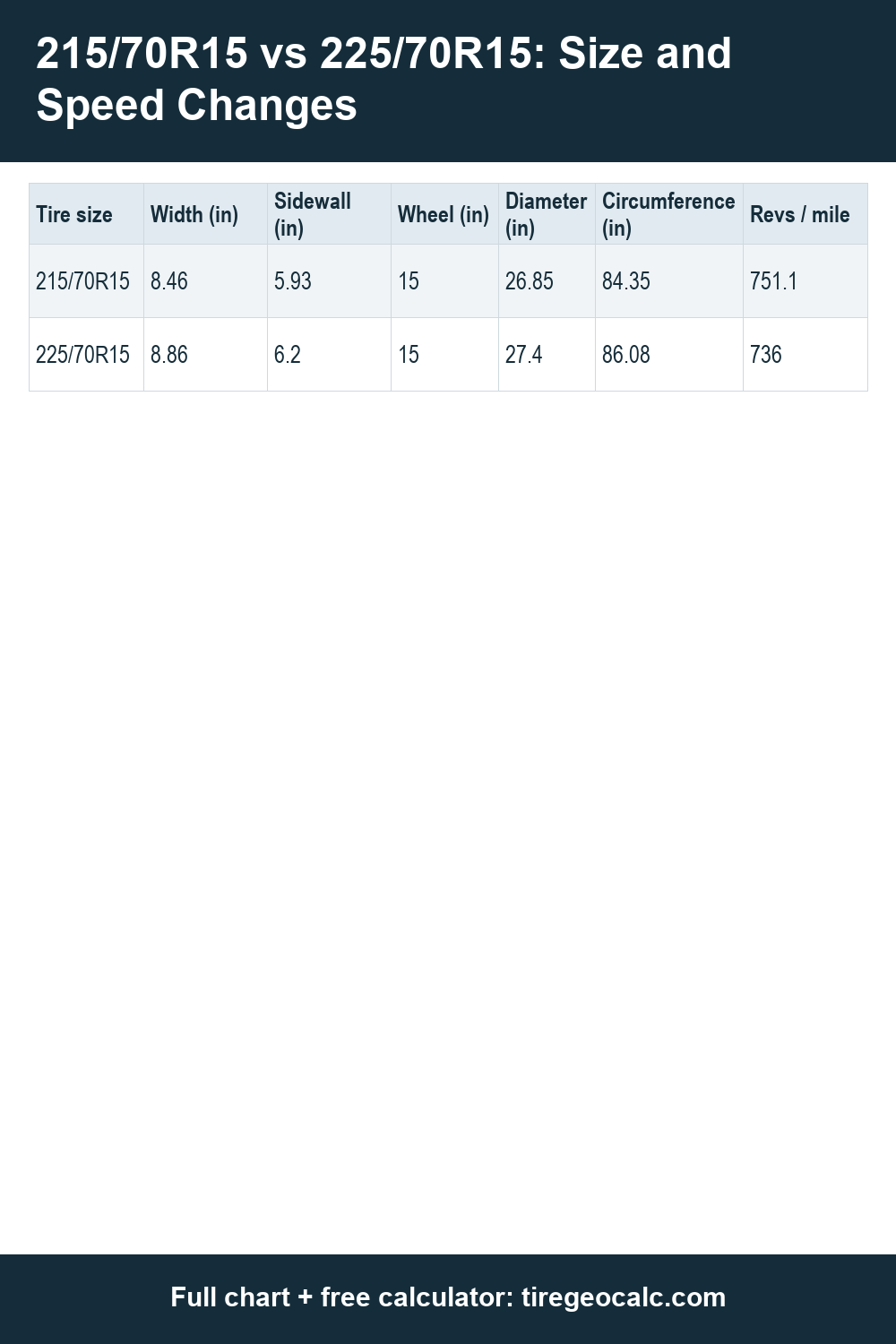
A taller sidewall from an unchanged seventy series label
The sidewall percentage is unchanged, yet the absolute sidewall grows. Since the same wheel is surrounded by that sidewall twice, the assembly height changes by twice the individual sidewall gain. The ideal radius change equals the gain of one sidewall in this particular same wheel comparison. That equality is a consequence of the geometry, not a vehicle clearance measurement.
The larger circumference affects both the theoretical speed ratio and the number of geometric revolutions per mile. If the vehicle retains calibration to the original, actual travel per counted revolution increases. Keep the direction of the comparison attached to the result, especially if someone later asks about returning from the wider size to the narrower one.
Speed, radius and wheel position in this pair
The key ratio in 215/70R15 versus 225/70R15 is 696.00 divided by 682.00, using millimeters for both diameters. That produces +2.05% change in ideal travel for each counted wheel revolution. Under unchanged original calibration, indicated 60 mph becomes theoretical 61.23 mph, with a signed difference of +1.23 mph. For a slower 30 mph indication the model gives 30.62 mph. Actual rolling measurements and the vehicle's existing instrument behavior are not inputs to those results.
The fifteen inch bead seat does not change between these older utility tire proportions. What grows is the sidewall, from 150.50 to 157.50 mm, making the candidate 14.00 mm taller overall. Only 7.00 mm of that total contributes to the ideal radius. This distinguishes a width research question from an unsupported capacity claim: a 225 mm section does not increase the vehicle's payload rating. If the original is being retained for a documented carrying specification, keep that requirement visible while reviewing any candidate product, even where the calculated size change looks modest beside the full 682.00 mm original diameter.
Put the dimensional result in context
For van related research, size code similarity must not replace the carrying requirements. A candidate tire needs the relevant construction, load and speed specification, and an approved wheel. Use those details to compare actual products after the dimensional shortlist. A taller sidewall or wider nominal section does not establish greater usable vehicle capacity.
Frequently asked questions
Why does the same seventy ratio matter on this fifteen inch pair?
For 215/70R15 versus 225/70R15, the added section is multiplied by seventy percent on each side of the wheel. The taller candidate may enter an older utility vehicle search as a possible wider alternative, yet it also changes the circle used by the instrument. Staying with the specified original avoids that introduced size change. A reason to investigate the candidate should be stated separately from any unsupported claim about payload or comfort. This pair supplies dimensions for a shortlist, while the exact vehicle documentation must supply acceptable wheel, tire and pressure requirements.
How does the outside height of 215/70R15 become a revolutions figure?
Multiplying 26.85 inches of diameter by pi gives 84.35 inches around the circle. One mile divided by that unrounded distance yields 751.13 revolutions. The calculation has no input for tread wear or tire deflection, so it cannot reconstruct the rolling travel of the physical tire currently on the vehicle.
Would a close speed change justify the wider fifteen inch option?
The theoretical instrument shift describes nominal circumference under the original calibration assumption. It does not establish an approved utility tire option, carrying capability or exact product fit. Use the result to frame the calibration question, then resolve the candidate's wheel range and vehicle requirements independently before making a purchase decision.
Continue your comparison
These are nominal geometric calculations, not vehicle fitment approval. Check the vehicle manual and exact tire and wheel specifications, including load and speed ratings, approved rim width and clearance; consult the manual for any diameter change exceeding 3%.
Reference tables: Load index chart and Speed rating chart.