 TireGeoCalc
215/55R16 vs 225/50R17: Size and Speed Changes
Quick answer
Nominal geometry215/55R16 → 225/50R17 · original-size calibration assumed
- Diameter difference
- +0.55in
- Diameter change
- +2.16%
- Actual at indicated 60 mph
- 61.30mph
Calculated from size markings. Not measured rolling dimensions or vehicle fitment approval.
Published
The move from 215/55R16 to 225/50R17 combines a wider section, a lower aspect ratio and a larger wheel. It is a complete wheel package question rather than a simple tire substitution. The chart keeps the original sixteen inch package as the reference and calculates how much of the wheel increase remains in overall height. Read the first size as the original throughout this comparison, including the speed and radius examples below.
Calculated tire dimensions and changes from the original
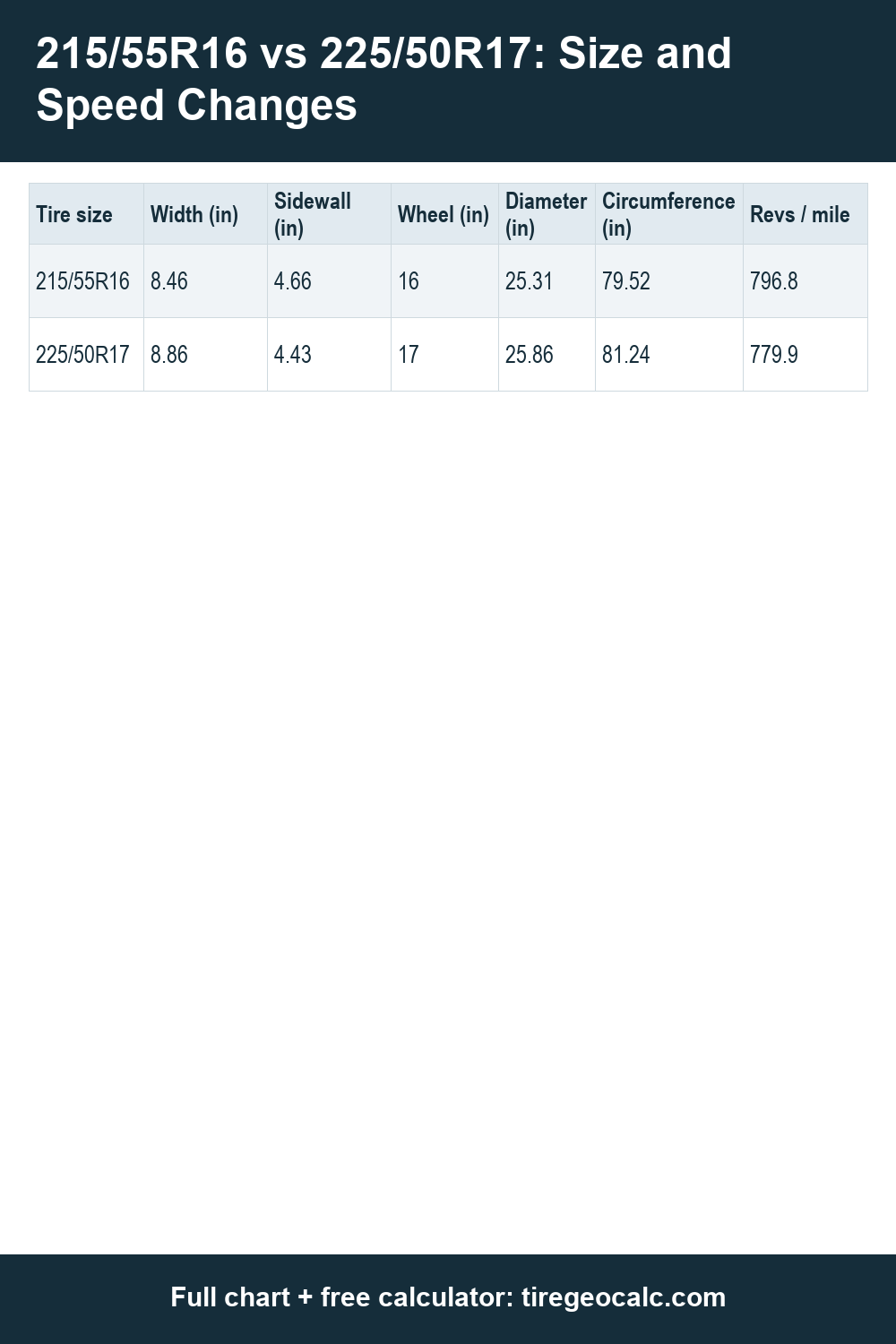
The first row, 215/55R16, is the original reference. All measurements are derived from the tire geometry engine. Percentages and theoretical speed values keep that same original throughout; rounding is for display only.
| Tire size | Width (mm) | Width (in) | Sidewall (mm) | Sidewall (in) | Wheel (mm) | Wheel (in) | Diameter (mm) | Diameter (in) | Circumference (mm) | Circumference (in) | Revolutions / mile | Revolutions / km | Diameter change (%) | Actual at indicated 30 mph | Actual at indicated 60 mph | Actual at indicated 75 mph | Actual minus indicated at 60 mph |
|---|---|---|---|---|---|---|---|---|---|---|---|---|---|---|---|---|---|
| 215/55R16 | 215 | 8.46 | 118.3 | 4.66 | 406.4 | 16 | 642.9 | 25.31 | 2019.7 | 79.52 | 796.8 | 495.1 | 0 | 30 | 60 | 75 | 0 |
| 225/50R17 | 225 | 8.86 | 112.5 | 4.43 | 431.8 | 17 | 656.8 | 25.86 | 2063.4 | 81.24 | 779.9 | 484.6 | 2.16 | 30.6 | 61.3 | 76.6 | 1.3 |
Nominal size-code geometry. Reference: 215/55R16. Display rounding only; not fitment approval.
- Tire size
- 215/55R16
- Width (mm)
- 215
- Width (in)
- 8.46
- Sidewall (mm)
- 118.3
- Sidewall (in)
- 4.66
- Wheel (mm)
- 406.4
- Wheel (in)
- 16
- Diameter (mm)
- 642.9
- Diameter (in)
- 25.31
- Circumference (mm)
- 2019.7
- Circumference (in)
- 79.52
- Revolutions / mile
- 796.8
- Revolutions / km
- 495.1
- Diameter change (%)
- 0
- Actual at indicated 30 mph
- 30
- Actual at indicated 60 mph
- 60
- Actual at indicated 75 mph
- 75
- Actual minus indicated at 60 mph
- 0
- Tire size
- 225/50R17
- Width (mm)
- 225
- Width (in)
- 8.86
- Sidewall (mm)
- 112.5
- Sidewall (in)
- 4.43
- Wheel (mm)
- 431.8
- Wheel (in)
- 17
- Diameter (mm)
- 656.8
- Diameter (in)
- 25.86
- Circumference (mm)
- 2063.4
- Circumference (in)
- 81.24
- Revolutions / mile
- 779.9
- Revolutions / km
- 484.6
- Diameter change (%)
- 2.16
- Actual at indicated 30 mph
- 30.6
- Actual at indicated 60 mph
- 61.3
- Actual at indicated 75 mph
- 76.6
- Actual minus indicated at 60 mph
- 1.3
Moving a family car from sixteen to seventeen inch wheels
The candidate's sidewall is shorter, but the extra wheel diameter is larger than the loss from its two sidewalls. The complete assembly therefore grows. This is why replacing a sixteen inch wheel with a seventeen inch wheel does not automatically preserve original height, even when the aspect ratio is reduced by five points.
For a compact family car, the first practical check is whether the proposed wheel package is documented for the exact vehicle configuration. Wheel attachment, brake clearance and offset are not in either tire code. The conversion can explain the dimensional change, but it cannot identify an approved optional wheel merely from the two markings.
Speed, radius and wheel position in this pair
The key ratio in 215/55R16 versus 225/50R17 is 656.80 divided by 642.90, using millimeters for both diameters. That produces +2.16% change in ideal travel for each counted wheel revolution. Under unchanged original calibration, indicated 60 mph becomes theoretical 61.30 mph, with a signed difference of +1.30 mph. For a slower 30 mph indication the model gives 30.65 mph. Actual rolling measurements and the vehicle's existing instrument behavior are not inputs to those results.
The proposed family car package gains 25.40 mm of wheel diameter but loses only 11.50 mm across its two sidewalls. A net 13.90 mm taller circle is the result, giving 6.95 mm more ideal radius. The wider 225 mm section does not explain that height by itself; most of the story is the wheel increase from sixteen to seventeen inches. If preserving outside height motivated the search, this pair needs a deliberate review rather than an assumption of equal diameter. The two tires cannot share a bead seat, and the candidate wheel needs its own complete application specification.
Put the dimensional result in context
Use the nominal speed change to frame a calibration question after the correct original size has been established. If the current sixteen inch tire was an earlier alteration, the chart's reference assumption may not describe the instrument. Keep original equipment, current equipment and proposed equipment in separate rows. That record is clearer than treating the tire currently on the car as a guaranteed factory baseline.
Frequently asked questions
Does reducing the ratio by five points balance the extra inch of wheel?
For 215/55R16 to 225/50R17, the two sidewalls lose less height than the wheel gains. The resulting assembly is taller, so this is not an equal diameter wheel swap. A family car owner researching an optional seventeen inch package needs to evaluate that net increase as well as the new wheel. Keeping the sixteen inch original may be appropriate where it is already the specified package. Choosing the candidate needs a documented reason and application checks, rather than the assumption that every five point ratio drop balances one wheel inch.
What nominal travel does one turn of 215/55R16 represent?
Its 642.90 mm circle gives 79.52 inches of calculated circumference. Dividing one mile by that travel gives 796.81 geometric revolutions. This refers to the ideal outside circle; a catalog rolling value under specified conditions is a different quantity and should retain its own measurement definition when you compare products.
What if the current sixteen inch set was already a modification?
The current tire is not automatically the correct speedometer reference. Establish the factory specification and any later calibration change before using this sixteen to seventeen inch comparison for instrument research. Keep all three packages named separately if original, current and proposed equipment differ, so the displayed ratio is applied to the intended baseline.
Continue your comparison
These are nominal geometric calculations, not vehicle fitment approval. Check the vehicle manual and exact tire and wheel specifications, including load and speed ratings, approved rim width and clearance; consult the manual for any diameter change exceeding 3%.
Verified against manufacturer data
Published specifications for the named models, checked on the dates below. Differences mean published minus calculated, divided by calculated. These are examples, not specifications for every tire of this size. P, LT and XL designations remain in the source row; matching nominal dimensions does not make their load capacities interchangeable.
| Size / model | Calculated diameter | Published diameter | Difference | Revolutions per mile: calculated / published (difference) | Source / checked |
|---|---|---|---|---|---|
| 225/50R17XL98V ToyoExtensa A/S II (148160) | 25.86 in | 25.90 in | +0.16% | 779.9 / not recorded in rev/mile | Toyo specifications |
| 225/50 R 1798V XL General TireAltiMAX RT45 (15577450000) | 25.86 in | 25.90 in | +0.16% | 779.9 / 803 (+2.96%) | General Tire specifications |
How we calculate: nominal geometry and measured rolling data can differ. This comparison is not vehicle fitment approval.
Reference tables: Load index chart and Speed rating chart.