 TireGeoCalc
205/65R15 vs 215/60R16: Size and Speed Changes
Quick answer
Nominal geometry205/65R15 → 215/60R16 · original-size calibration assumed
- Diameter difference
- +0.67in
- Diameter change
- +2.61%
- Actual at indicated 60 mph
- 61.57mph
Calculated from size markings. Not measured rolling dimensions or vehicle fitment approval.
Published
205/65R15 versus 215/60R16 is a passenger wheel package comparison with three moving inputs. The candidate is wider, has a lower aspect ratio and uses a sixteen inch wheel instead of fifteen. The larger wheel is partly offset by shorter sidewalls, so the complete height change must be calculated rather than read from the last number. Read the first size as the original throughout this comparison, including the speed and radius examples below.
Calculated tire dimensions and changes from the original
The first row, 205/65R15, is the original reference. All measurements are derived from the tire geometry engine. Percentages and theoretical speed values keep that same original throughout; rounding is for display only.
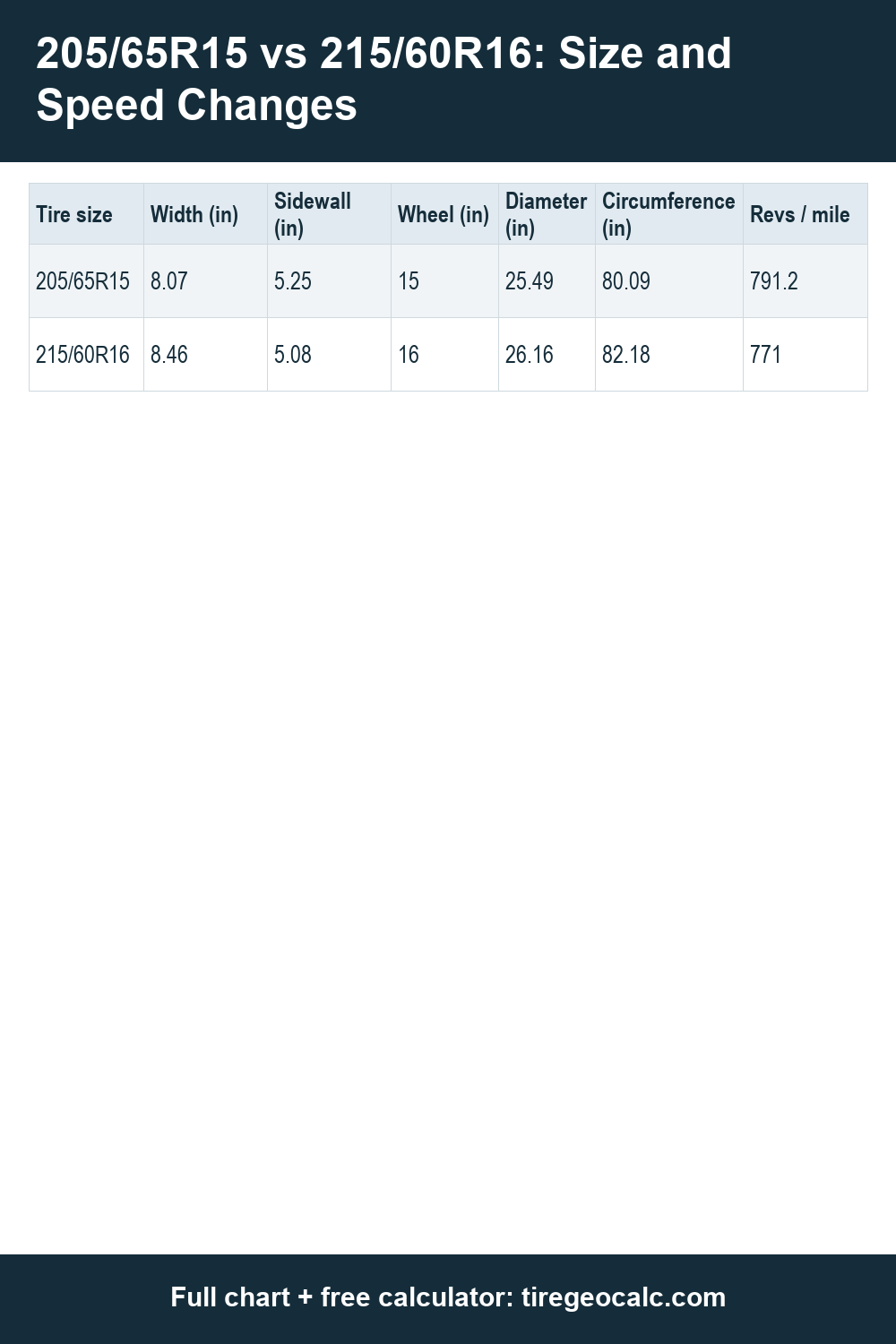
| Tire size | Width (mm) | Width (in) | Sidewall (mm) | Sidewall (in) | Wheel (mm) | Wheel (in) | Diameter (mm) | Diameter (in) | Circumference (mm) | Circumference (in) | Revolutions / mile | Revolutions / km | Diameter change (%) | Actual at indicated 30 mph | Actual at indicated 60 mph | Actual at indicated 75 mph | Actual minus indicated at 60 mph |
|---|---|---|---|---|---|---|---|---|---|---|---|---|---|---|---|---|---|
| 205/65R15 | 205 | 8.07 | 133.3 | 5.25 | 381 | 15 | 647.5 | 25.49 | 2034.2 | 80.09 | 791.2 | 491.6 | 0 | 30 | 60 | 75 | 0 |
| 215/60R16 | 215 | 8.46 | 129 | 5.08 | 406.4 | 16 | 664.4 | 26.16 | 2087.3 | 82.18 | 771 | 479.1 | 2.61 | 30.8 | 61.6 | 77 | 1.6 |
Nominal size-code geometry. Reference: 205/65R15. Display rounding only; not fitment approval.
- Tire size
- 205/65R15
- Width (mm)
- 205
- Width (in)
- 8.07
- Sidewall (mm)
- 133.3
- Sidewall (in)
- 5.25
- Wheel (mm)
- 381
- Wheel (in)
- 15
- Diameter (mm)
- 647.5
- Diameter (in)
- 25.49
- Circumference (mm)
- 2034.2
- Circumference (in)
- 80.09
- Revolutions / mile
- 791.2
- Revolutions / km
- 491.6
- Diameter change (%)
- 0
- Actual at indicated 30 mph
- 30
- Actual at indicated 60 mph
- 60
- Actual at indicated 75 mph
- 75
- Actual minus indicated at 60 mph
- 0
- Tire size
- 215/60R16
- Width (mm)
- 215
- Width (in)
- 8.46
- Sidewall (mm)
- 129
- Sidewall (in)
- 5.08
- Wheel (mm)
- 406.4
- Wheel (in)
- 16
- Diameter (mm)
- 664.4
- Diameter (in)
- 26.16
- Circumference (mm)
- 2087.3
- Circumference (in)
- 82.18
- Revolutions / mile
- 771
- Revolutions / km
- 479.1
- Diameter change (%)
- 2.61
- Actual at indicated 30 mph
- 30.8
- Actual at indicated 60 mph
- 61.6
- Actual at indicated 75 mph
- 77
- Actual minus indicated at 60 mph
- 1.6
More wheel and less sidewall with a net height increase
The lower ratio reduces sidewall height despite the added nominal width. However, the wheel diameter increase more than replaces the lost rubber height. The candidate remains taller overall. This separates a potential change in sidewall proportion from a change in the complete circle used for calibration and ideal radius calculations.
The fifteen inch original tire and sixteen inch candidate require different wheels. Confirming outside height alone cannot establish that the proposed sixteen inch wheel clears brakes, attaches correctly or has suitable width and offset. Keep wheel compatibility as its own part of the replacement record rather than treating the tire table as a complete package specification.
Speed, radius and wheel position in this pair
Starting from 205/65R15, the candidate 215/60R16 has 26.16 inches of calculated height instead of 25.49. Its +16.90 mm diameter change amounts to +2.61% of the original. The speed example follows the same ratio: a 60 mph indication becomes 61.57 mph theoretically, while 75 indicated becomes 76.96 mph. Reversing the original and candidate would change the denominator, so a return to the first size requires a fresh calculation rather than merely reversing a rounded percentage sign.
This family sedan wheel change replaces a fifteen inch center with a sixteen inch one. Sidewall falls by 4.25 mm on each side, which absorbs 8.50 mm of the added 25.40 mm wheel diameter. The remaining 16.90 mm increases the outside circle, and half of it, 8.45 mm, is the ideal radius gain. A person choosing between complete packages should therefore compare the net tire height as well as the wheel appearance. The candidate requires a different bead seat, and tire geometry cannot identify its attachment, offset or space around the brake assembly.
Put the dimensional result in context
For a family sedan or older passenger vehicle, the documented original matters more than the size currently installed. If someone has already changed the wheels, verify which size the instrument assumes before applying the chart's speed result. A nominal ratio can describe the candidate accurately while still being the wrong reference for that particular vehicle's existing calibration.
Frequently asked questions
Is this a complete wheel change rather than a tire change?
205/65R15 cannot be installed on the sixteen inch wheel required by 215/60R16. An owner considering a larger family sedan wheel must therefore compare the complete packages, including attachment and offset. The candidate has less sidewall but more total height, so a wheel upgrade does not automatically preserve circumference. Retaining the original is the natural geometric reference; investigating the candidate calls for a documented package and calibration assessment. Obtain the wheel identity before buying a tire, since the table contains no evidence about the space behind its spokes or around the brakes.
How does the outside height of 205/65R15 become a revolutions figure?
Multiplying 25.49 inches of diameter by pi gives 80.09 inches around the circle. One mile divided by that unrounded distance yields 791.15 revolutions. The calculation has no input for tread wear or tire deflection, so it cannot reconstruct the rolling travel of the physical tire currently on the vehicle.
Does reduced sidewall mean the sixteen inch candidate is lower overall?
For this passenger wheel package, the added wheel diameter exceeds the combined sidewall loss. A lower ratio and a taller total assembly therefore coexist. If the reason for changing is to preserve height, check the net circle rather than stopping at the smaller ratio, and keep the different wheel requirement in the purchase record.
Continue your comparison
These are nominal geometric calculations, not vehicle fitment approval. Check the vehicle manual and exact tire and wheel specifications, including load and speed ratings, approved rim width and clearance; consult the manual for any diameter change exceeding 3%.
Verified against manufacturer data
Published specifications for the named models, checked on the dates below. Differences mean published minus calculated, divided by calculated. These are examples, not specifications for every tire of this size. P, LT and XL designations remain in the source row; matching nominal dimensions does not make their load capacities interchangeable.
| Size / model | Calculated diameter | Published diameter | Difference | Revolutions per mile: calculated / published (difference) | Source / checked |
|---|---|---|---|---|---|
| 215/60R1695H ToyoExtensa A/S II (147030) | 26.16 in | 26.10 in | -0.22% | 771.0 / not recorded in rev/mile | Toyo specifications |
| 215/60 R 1695V SL General TireAltiMAX RT45 (15577390000) | 26.16 in | 26.20 in | +0.16% | 771.0 / 794 (+2.98%) | General Tire specifications |
How we calculate: nominal geometry and measured rolling data can differ. This comparison is not vehicle fitment approval.
Reference tables: Load index chart and Speed rating chart.