 TireGeoCalc
205/45R17 vs 215/45R17: Size and Speed Changes
Quick answer
Nominal geometry205/45R17 → 215/45R17 · original-size calibration assumed
- Diameter difference
- +0.35in
- Diameter change
- +1.46%
- Actual at indicated 60 mph
- 60.88mph
Calculated from size markings. Not measured rolling dimensions or vehicle fitment approval.
Published
205/45R17 versus 215/45R17 is a width change on the same seventeen inch wheel. Applying an unchanged forty five percent ratio to the wider section also adds sidewall. For a small sporty hatchback or compact car search, the useful result is a wider and slightly taller nominal assembly rather than a width change alone. Read the first size as the original throughout this comparison, including the speed and radius examples below.
Calculated tire dimensions and changes from the original
The first row, 205/45R17, is the original reference. All measurements are derived from the tire geometry engine. Percentages and theoretical speed values keep that same original throughout; rounding is for display only.
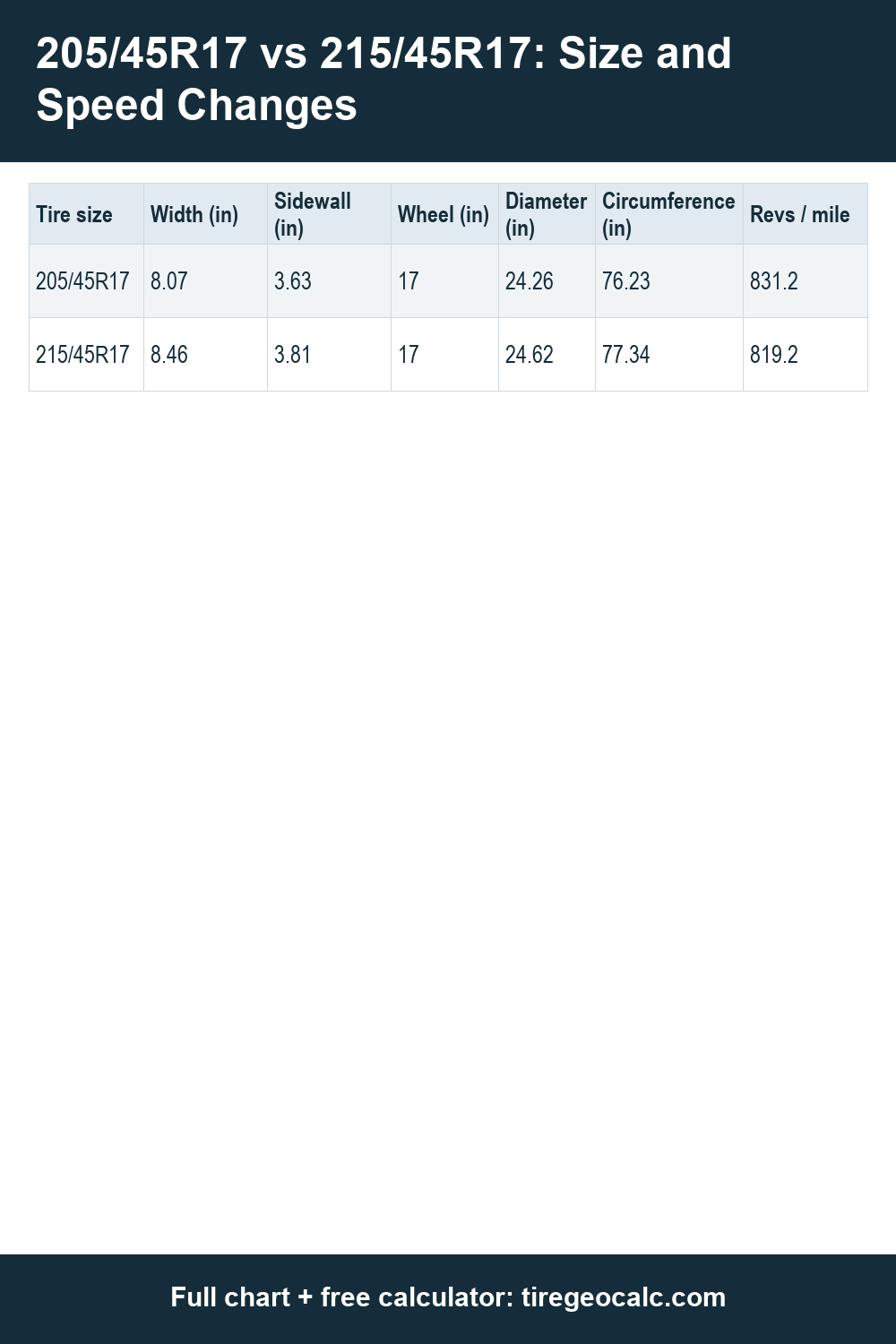
| Tire size | Width (mm) | Width (in) | Sidewall (mm) | Sidewall (in) | Wheel (mm) | Wheel (in) | Diameter (mm) | Diameter (in) | Circumference (mm) | Circumference (in) | Revolutions / mile | Revolutions / km | Diameter change (%) | Actual at indicated 30 mph | Actual at indicated 60 mph | Actual at indicated 75 mph | Actual minus indicated at 60 mph |
|---|---|---|---|---|---|---|---|---|---|---|---|---|---|---|---|---|---|
| 205/45R17 | 205 | 8.07 | 92.3 | 3.63 | 431.8 | 17 | 616.3 | 24.26 | 1936.2 | 76.23 | 831.2 | 516.5 | 0 | 30 | 60 | 75 | 0 |
| 215/45R17 | 215 | 8.46 | 96.8 | 3.81 | 431.8 | 17 | 625.3 | 24.62 | 1964.4 | 77.34 | 819.2 | 509.1 | 1.46 | 30.4 | 60.9 | 76.1 | 0.9 |
Nominal size-code geometry. Reference: 205/45R17. Display rounding only; not fitment approval.
- Tire size
- 205/45R17
- Width (mm)
- 205
- Width (in)
- 8.07
- Sidewall (mm)
- 92.3
- Sidewall (in)
- 3.63
- Wheel (mm)
- 431.8
- Wheel (in)
- 17
- Diameter (mm)
- 616.3
- Diameter (in)
- 24.26
- Circumference (mm)
- 1936.2
- Circumference (in)
- 76.23
- Revolutions / mile
- 831.2
- Revolutions / km
- 516.5
- Diameter change (%)
- 0
- Actual at indicated 30 mph
- 30
- Actual at indicated 60 mph
- 60
- Actual at indicated 75 mph
- 75
- Actual minus indicated at 60 mph
- 0
- Tire size
- 215/45R17
- Width (mm)
- 215
- Width (in)
- 8.46
- Sidewall (mm)
- 96.8
- Sidewall (in)
- 3.81
- Wheel (mm)
- 431.8
- Wheel (in)
- 17
- Diameter (mm)
- 625.3
- Diameter (in)
- 24.62
- Circumference (mm)
- 1964.4
- Circumference (in)
- 77.34
- Revolutions / mile
- 819.2
- Revolutions / km
- 509.1
- Diameter change (%)
- 1.46
- Actual at indicated 30 mph
- 30.4
- Actual at indicated 60 mph
- 60.9
- Actual at indicated 75 mph
- 76.1
- Actual minus indicated at 60 mph
- 0.9
A small hatchback width increase at the same forty five ratio
The sidewall gain is larger per unit of width than it would be in a thirty five series comparison. That is because the ratio is a multiplier. This pair shows why a ten millimeter width step does not have one universal effect on tire diameter across all tire sizes. Read the actual ratio before borrowing a rule from a different wheel package.
The extra ideal radius raises the geometric contribution to ground clearance, but the loaded tire and vehicle are not modeled. The same candidate also moves its nominal outer circle closer to nearby components. These observations frame two different clearance questions without answering either one for an actual car.
Speed, radius and wheel position in this pair
With 205/45R17 as original, 215/45R17 changes the calculated outside diameter from 616.30 to 625.30 mm. The signed difference is +9.00 mm (+0.35 inches), or +1.46%. At an indicated 60 mph, original circumference calibration would give 60.88 mph on the candidate, a +0.88 mph shift. At an indicated 30 mph the corresponding value is 30.44 mph. These numbers compare two ideal circles rather than measuring the existing instrument error.
At forty five percent, the width step in this hatchback pair contributes 4.50 mm to each sidewall. The resulting outside increase is 9.00 mm and the ideal radius increase is 4.50 mm. A thirty five series comparison with the same width increment would have a different height result, so borrowing its percentage would answer the wrong question. The seventeen inch wheel remains unchanged here. An owner researching a wider documented option should bring the exact product, wheel width and offset into the clearance check; staying with the original keeps the reference circle without establishing anything about the condition of the existing tires.
Put the dimensional result in context
Small car wheel arches can make the exact wheel and tire important even when a diameter percentage looks modest. Obtain approved rim information, offset and product dimensions, then consider clearance through steering and suspension movement. Keep the original calibration assumption with the speed result. A small calculated percentage is a screening fact, not a complete replacement decision.
Frequently asked questions
How does this hatchback width step differ from a 35 series step?
205/45R17 to 215/45R17 applies forty five percent to the width increase, giving more added height than the same width step at thirty five percent. A sporty hatchback owner should calculate this pair rather than borrowing a diameter result from a larger performance wheel. The candidate may be researched as a documented wider option, while the original remains the reference for retaining the present circle. Neither choice can be justified by a universal ten millimeter rule: the exact ratio, rim approval and installed clearance still control the relevant questions.
Which distance definition accompanies the revolution count for 205/45R17?
The nominal circle covers 76.23 inches per revolution, giving 831.20 turns over a mile. These figures derive from 616.30 mm of outside diameter before rounding. A manufacturer's rolling figure may use specified operating conditions, so keep that product information distinct from the size code calculation instead of mixing the two definitions in one comparison.
Does the ideal radius increase predict loaded hatchback clearance?
The circle model does not contain tire deflection, operating pressure or the vehicle's actual load. Its added radius identifies the direction of a geometric change, not a measured increase beneath the loaded car. Use suitable installed evidence for a clearance question and keep it separate from the nominal forty five series arithmetic.
Continue your comparison
These are nominal geometric calculations, not vehicle fitment approval. Check the vehicle manual and exact tire and wheel specifications, including load and speed ratings, approved rim width and clearance; consult the manual for any diameter change exceeding 3%.
Verified against manufacturer data
Published specifications for the named models, checked on the dates below. Differences mean published minus calculated, divided by calculated. These are examples, not specifications for every tire of this size. P, LT and XL designations remain in the source row; matching nominal dimensions does not make their load capacities interchangeable.
| Size / model | Calculated diameter | Published diameter | Difference | Revolutions per mile: calculated / published (difference) | Source / checked |
|---|---|---|---|---|---|
| 215/45R1791V ToyoCelsius II (243640) | 24.62 in | 24.60 in | -0.07% | 819.2 / not recorded in rev/mile | Toyo specifications |
| 215/45 R 1791V XL General TireAltiMAX RT45 (15577350000) | 24.62 in | 24.60 in | -0.07% | 819.2 / 844 (+3.02%) | General Tire specifications |
How we calculate: nominal geometry and measured rolling data can differ. This comparison is not vehicle fitment approval.
Reference tables: Load index chart and Speed rating chart.