 TireGeoCalc
195/55R16 vs 205/50R17: Size and Speed Changes
Quick answer
Nominal geometry195/55R16 → 205/50R17 · original-size calibration assumed
- Diameter difference
- +0.63in
- Diameter change
- +2.56%
- Actual at indicated 60 mph
- 61.54mph
Calculated from size markings. Not measured rolling dimensions or vehicle fitment approval.
Published
This small passenger car comparison moves from 195/55R16 to 205/50R17. Nominal width rises, aspect ratio falls and the wheel grows by an inch. The candidate's shorter sidewall absorbs part of the wheel increase, but the full outside height still needs calculation before making a calibration or clearance comparison. Read the first size as the original throughout this comparison, including the speed and radius examples below.
Calculated tire dimensions and changes from the original
The first row, 195/55R16, is the original reference. All measurements are derived from the tire geometry engine. Percentages and theoretical speed values keep that same original throughout; rounding is for display only.
| Tire size | Width (mm) | Width (in) | Sidewall (mm) | Sidewall (in) | Wheel (mm) | Wheel (in) | Diameter (mm) | Diameter (in) | Circumference (mm) | Circumference (in) | Revolutions / mile | Revolutions / km | Diameter change (%) | Actual at indicated 30 mph | Actual at indicated 60 mph | Actual at indicated 75 mph | Actual minus indicated at 60 mph |
|---|---|---|---|---|---|---|---|---|---|---|---|---|---|---|---|---|---|
| 195/55R16 | 195 | 7.68 | 107.3 | 4.22 | 406.4 | 16 | 620.9 | 24.44 | 1950.6 | 76.8 | 825 | 512.7 | 0 | 30 | 60 | 75 | 0 |
| 205/50R17 | 205 | 8.07 | 102.5 | 4.04 | 431.8 | 17 | 636.8 | 25.07 | 2000.6 | 78.76 | 804.4 | 499.9 | 2.56 | 30.8 | 61.5 | 76.9 | 1.5 |
Nominal size-code geometry. Reference: 195/55R16. Display rounding only; not fitment approval.
- Tire size
- 195/55R16
- Width (mm)
- 195
- Width (in)
- 7.68
- Sidewall (mm)
- 107.3
- Sidewall (in)
- 4.22
- Wheel (mm)
- 406.4
- Wheel (in)
- 16
- Diameter (mm)
- 620.9
- Diameter (in)
- 24.44
- Circumference (mm)
- 1950.6
- Circumference (in)
- 76.8
- Revolutions / mile
- 825
- Revolutions / km
- 512.7
- Diameter change (%)
- 0
- Actual at indicated 30 mph
- 30
- Actual at indicated 60 mph
- 60
- Actual at indicated 75 mph
- 75
- Actual minus indicated at 60 mph
- 0
- Tire size
- 205/50R17
- Width (mm)
- 205
- Width (in)
- 8.07
- Sidewall (mm)
- 102.5
- Sidewall (in)
- 4.04
- Wheel (mm)
- 431.8
- Wheel (in)
- 17
- Diameter (mm)
- 636.8
- Diameter (in)
- 25.07
- Circumference (mm)
- 2000.6
- Circumference (in)
- 78.76
- Revolutions / mile
- 804.4
- Revolutions / km
- 499.9
- Diameter change (%)
- 2.56
- Actual at indicated 30 mph
- 30.8
- Actual at indicated 60 mph
- 61.5
- Actual at indicated 75 mph
- 76.9
- Actual minus indicated at 60 mph
- 1.5
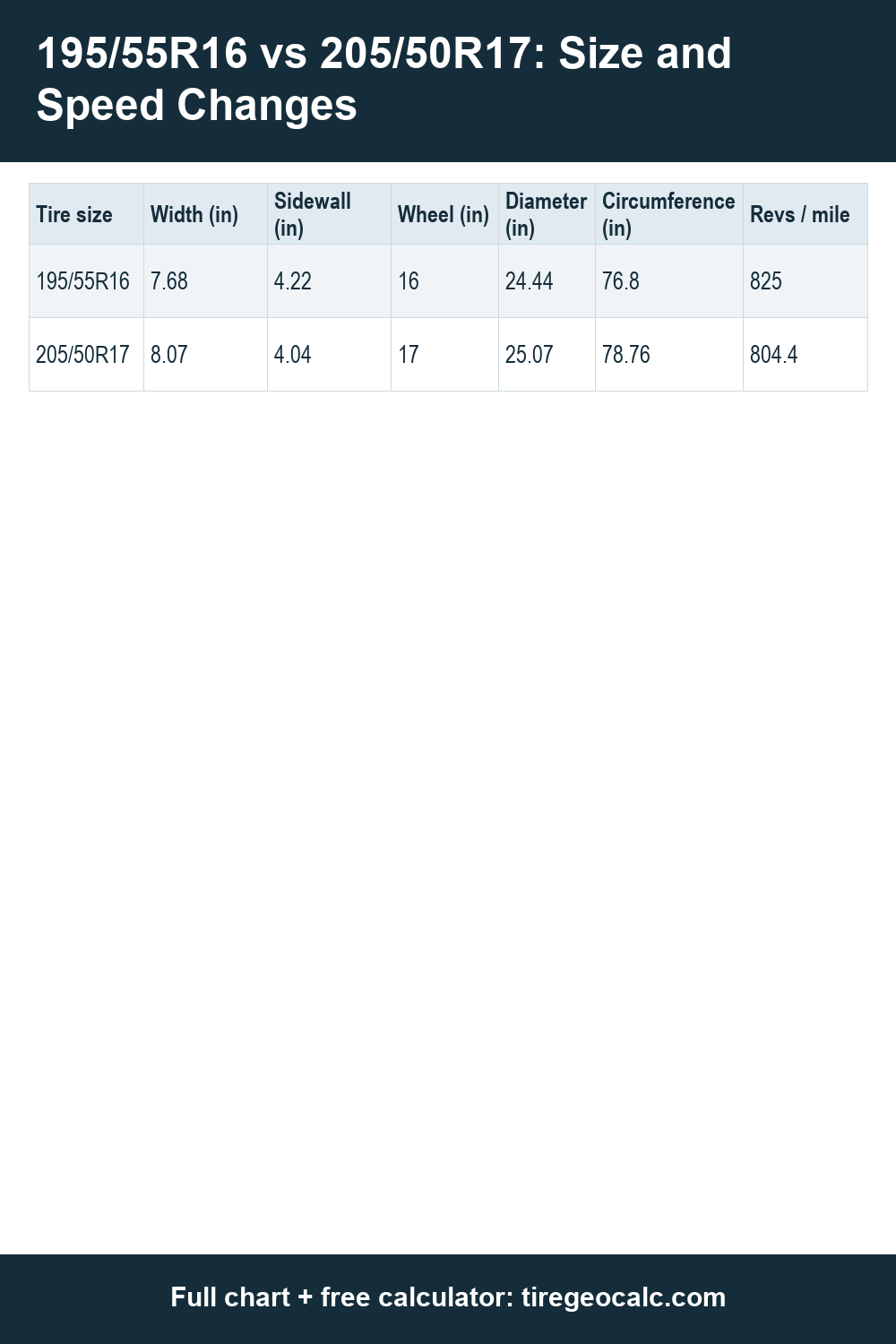
A small car wheel increase with two competing sidewall inputs
The original and candidate are not the same height. Applying the lower percentage to a slightly wider section produces less sidewall, yet adding the larger wheel leaves a taller assembly. The candidate therefore combines a shorter nominal sidewall with a larger radius. Those two results can coexist and should not be collapsed into a general claim about a lower profile tire.
If the original sixteen inch wheels are being retained, the seventeen inch candidate is not a mounting option. If new wheels are planned, collect the full specifications rather than selecting by diameter. Attachment, wheel width, offset and brake clearance are outside the nominal tire calculation. A close looking wheel in a listing does not establish those details.
Speed, radius and wheel position in this pair
With 195/55R16 as original, 205/50R17 changes the calculated outside diameter from 620.90 to 636.80 mm. The signed difference is +15.90 mm (+0.63 inches), or +2.56%. At an indicated 60 mph, original circumference calibration would give 61.54 mph on the candidate, a +1.54 mph shift. At an indicated 30 mph the corresponding value is 30.77 mph. These numbers compare two ideal circles rather than measuring the existing instrument error.
On this small car comparison, 195/55R16 has 107.25 mm sidewalls while 205/50R17 has 102.50 mm. Removing 9.50 mm of combined rubber height only partly offsets the move from sixteen to seventeen inches of wheel. The completed circle gains 15.90 mm and ideal radius gains 7.95 mm. Those results explain how a lower profile can coexist with a taller outside assembly. Investigating the larger wheel for appearance needs the exact vehicle package evidence as well; retaining the original avoids assuming that a smaller ratio alone keeps circumference unchanged, and the candidate cannot be mounted on the current sixteen inch wheel.
Put the dimensional result in context
For a small car, retaining documented load and speed requirements remains part of the comparison even if most attention is on appearance. The table cannot infer them from width or wheel diameter. Keep the candidate's exact tire model and service description with the wheel data, and treat the nominal speed change as a question to assess after the original calibration is known.
Frequently asked questions
Could I fit the second tire to my current sixteen inch wheels?
195/55R16 and 205/50R17 require different bead seat diameters. The second tire belongs in a new wheel package discussion, not an order for rubber on the existing sixteen inch wheels. A small car owner interested in the appearance of seventeen inch wheels should compare the net height increase and the documented wheel application together. Keeping the original avoids both the wheel purchase and the altered nominal circle. If the candidate is being investigated, record its full wheel and tire requirements before interpreting the lower ratio as an equal height conversion.
Is the circumference for 195/55R16 measured on a loaded car?
No loaded measurement enters this result: 1950.61 mm follows mathematically from the size code diameter. It corresponds to 825.04 ideal revolutions per mile. If your question concerns a particular tire under load, preserve the actual product and test conditions rather than treating this nominal circumference as an observed rolling distance.
What must accompany a new seventeen inch small car wheel?
The proposed wheel needs its own identity and application details, not just a tire already mounted for a photograph. Obtain width, offset, attachment and brake clearance evidence. The candidate's increased total circle and shorter sidewall explain its proportions, but neither can identify an approved wheel for the small car being considered.
Continue your comparison
These are nominal geometric calculations, not vehicle fitment approval. Check the vehicle manual and exact tire and wheel specifications, including load and speed ratings, approved rim width and clearance; consult the manual for any diameter change exceeding 3%.
Verified against manufacturer data
Published specifications for the named models, checked on the dates below. Differences mean published minus calculated, divided by calculated. These are examples, not specifications for every tire of this size. P, LT and XL designations remain in the source row; matching nominal dimensions does not make their load capacities interchangeable.
| Size / model | Calculated diameter | Published diameter | Difference | Revolutions per mile: calculated / published (difference) | Source / checked |
|---|---|---|---|---|---|
| 195/55R1687V ToyoExtensa A/S II (148110) | 24.44 in | 24.40 in | -0.18% | 825.0 / not recorded in rev/mile | Toyo specifications |
| 195/55 R 1687V SL General TireAltiMAX RT45 (15577240000) | 24.44 in | 24.40 in | -0.18% | 825.0 / 850 (+3.02%) | General Tire specifications |
| 205/50R17XL93V ToyoExtensa A/S II (148610) | 25.07 in | 25.10 in | +0.12% | 804.4 / not recorded in rev/mile | Toyo specifications |
| 205/50 R 1793V XL General TireAltiMAX RT45 (15577290000) | 25.07 in | 25.10 in | +0.12% | 804.4 / 829 (+3.05%) | General Tire specifications |
How we calculate: nominal geometry and measured rolling data can differ. This comparison is not vehicle fitment approval.
Reference tables: Load index chart and Speed rating chart.