 TireGeoCalc
175/65R14 vs 185/60R15: Size and Speed Changes
Quick answer
Nominal geometry175/65R14 → 185/60R15 · original-size calibration assumed
- Diameter difference
- +0.78in
- Diameter change
- +3.41%
- Actual at indicated 60 mph
- 62.05mph
Calculated from size markings. Not measured rolling dimensions or vehicle fitment approval.
Published
175/65R14 versus 185/60R15 compares two compact passenger tire proportions on different wheel diameters. The candidate has a lower ratio and a wider section around a larger wheel. This is useful for understanding older economy car wheel changes, but it cannot identify an approved conversion for an unspecified vehicle. Read the first size as the original throughout this comparison, including the speed and radius examples below.
Calculated tire dimensions and changes from the original
The first row, 175/65R14, is the original reference. All measurements are derived from the tire geometry engine. Percentages and theoretical speed values keep that same original throughout; rounding is for display only.
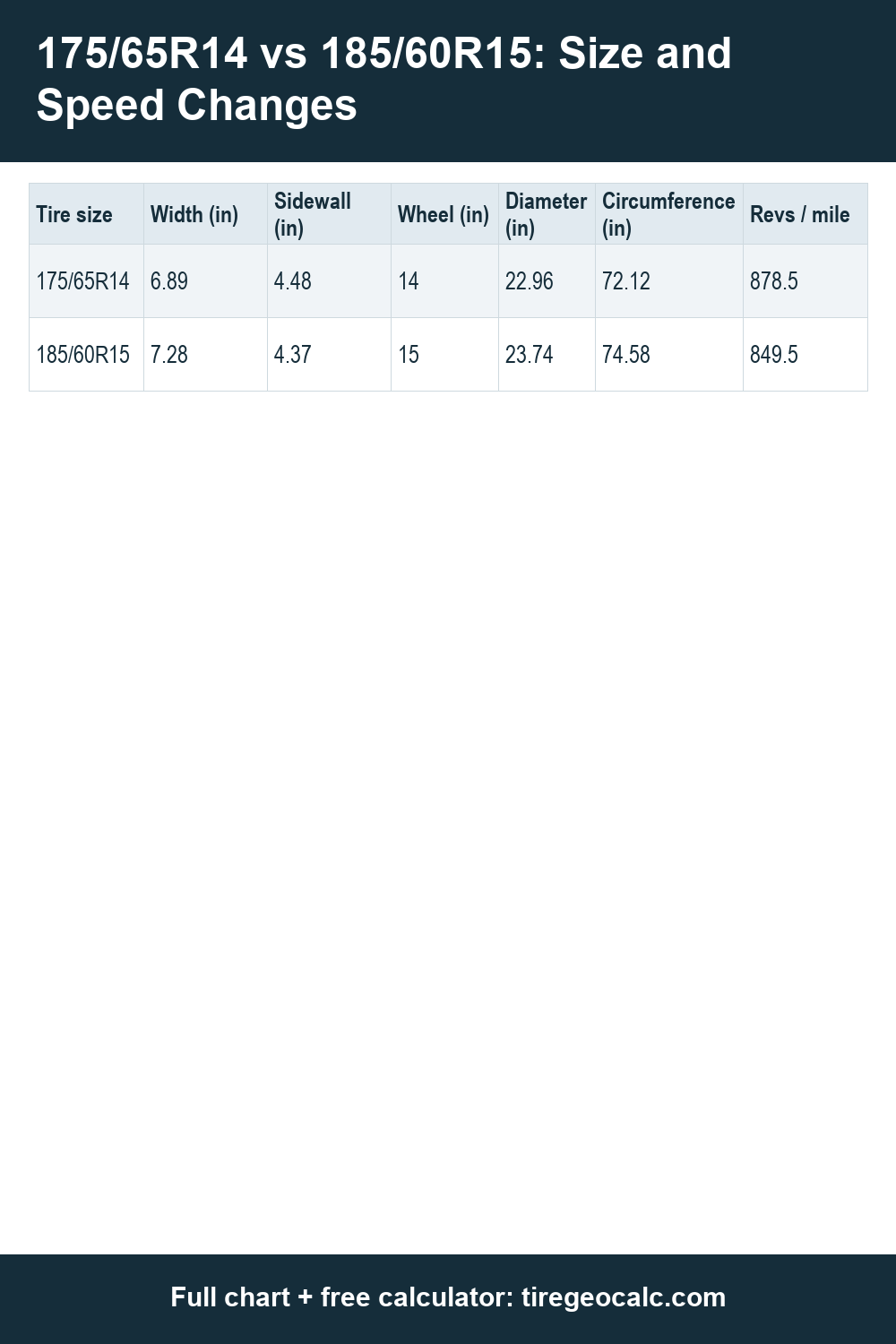
| Tire size | Width (mm) | Width (in) | Sidewall (mm) | Sidewall (in) | Wheel (mm) | Wheel (in) | Diameter (mm) | Diameter (in) | Circumference (mm) | Circumference (in) | Revolutions / mile | Revolutions / km | Diameter change (%) | Actual at indicated 30 mph | Actual at indicated 60 mph | Actual at indicated 75 mph | Actual minus indicated at 60 mph |
|---|---|---|---|---|---|---|---|---|---|---|---|---|---|---|---|---|---|
| 175/65R14 | 175 | 6.89 | 113.8 | 4.48 | 355.6 | 14 | 583.1 | 22.96 | 1831.9 | 72.12 | 878.5 | 545.9 | 0 | 30 | 60 | 75 | 0 |
| 185/60R15 | 185 | 7.28 | 111 | 4.37 | 381 | 15 | 603 | 23.74 | 1894.4 | 74.58 | 849.5 | 527.9 | 3.41 | 31 | 62 | 77.6 | 2 |
Nominal size-code geometry. Reference: 175/65R14. Display rounding only; not fitment approval.
- Tire size
- 175/65R14
- Width (mm)
- 175
- Width (in)
- 6.89
- Sidewall (mm)
- 113.8
- Sidewall (in)
- 4.48
- Wheel (mm)
- 355.6
- Wheel (in)
- 14
- Diameter (mm)
- 583.1
- Diameter (in)
- 22.96
- Circumference (mm)
- 1831.9
- Circumference (in)
- 72.12
- Revolutions / mile
- 878.5
- Revolutions / km
- 545.9
- Diameter change (%)
- 0
- Actual at indicated 30 mph
- 30
- Actual at indicated 60 mph
- 60
- Actual at indicated 75 mph
- 75
- Actual minus indicated at 60 mph
- 0
- Tire size
- 185/60R15
- Width (mm)
- 185
- Width (in)
- 7.28
- Sidewall (mm)
- 111
- Sidewall (in)
- 4.37
- Wheel (mm)
- 381
- Wheel (in)
- 15
- Diameter (mm)
- 603
- Diameter (in)
- 23.74
- Circumference (mm)
- 1894.4
- Circumference (in)
- 74.58
- Revolutions / mile
- 849.5
- Revolutions / km
- 527.9
- Diameter change (%)
- 3.41
- Actual at indicated 30 mph
- 31
- Actual at indicated 60 mph
- 62
- Actual at indicated 75 mph
- 77.6
- Actual minus indicated at 60 mph
- 2
Older compact car packages across fourteen and fifteen inches
The sidewall becomes only slightly shorter because the extra width offsets much of the ratio reduction. The larger wheel therefore produces a noticeable net diameter increase. This differs from a wheel conversion that preserves almost all of the original height by removing much more sidewall. Follow the full calculation rather than assuming a five point ratio drop always compensates for another inch of wheel.
Older cars may have nonoriginal wheels fitted during previous ownership. Establish the documented original and record the current equipment separately. The speed calculation on this page assumes calibration to 175/65R14; it does not reconstruct past changes or account for a recalibrated instrument. Preserve that assumption when sharing a result.
Speed, radius and wheel position in this pair
Take the 22.96 inch circle of 175/65R14 as the calibration reference. Substituting the 23.74 inch circle of 185/60R15 changes travel per revolution by +3.41%. An unchanged instrument reading 60 mph would correspond to a modeled 62.05 mph, and a 75 mph reading to 77.56 mph. The candidate diameter differs by +19.90 mm in total. This calculation assumes the original circle defined calibration; a previously changed wheel package or a recalibrated instrument needs its own reference.
The two compact car sidewalls are unusually close in this particular wheel swap: 113.75 mm originally and 111.00 mm on the candidate. Only 5.50 mm disappears across both sides, leaving most of the extra wheel inch in the tire's outside height. The net diameter gain is 19.90 mm and the ideal radius gain is 9.95 mm. That is why a five point ratio reduction is an unreliable shortcut here. An owner researching a fifteen inch package should establish the documented configuration and complete wheel identity, especially where stored wheels or an earlier owner's changes are part of the inquiry.
Put the dimensional result in context
The change also needs a fifteen inch wheel with suitable application details. Wheel diameter alone says nothing about attachment, brake clearance, offset or width. If stored wheels are involved, condition and identification need their own assessment. Matching nominal tire geometry cannot establish that an old wheel or tire is serviceable, correctly specified or appropriate for continued use.
Frequently asked questions
Why is this older compact car wheel swap noticeably taller?
Changing 175/65R14 to 185/60R15 removes very little sidewall because the wider section offsets much of the lower ratio. Most of the added wheel diameter therefore remains in the outside height. A driver researching a fifteen inch package should establish whether that larger circle belongs to a documented configuration for the exact car. Retaining the original avoids assuming that old wheels or a previous owner's conversion are appropriate. The candidate may be worth researching for a specified package, but a five point ratio reduction alone is not the evidence needed.
Is the circumference for 175/65R14 measured on a loaded car?
No loaded measurement enters this result: 1831.86 mm follows mathematically from the size code diameter. It corresponds to 878.53 ideal revolutions per mile. If your question concerns a particular tire under load, preserve the actual product and test conditions rather than treating this nominal circumference as an observed rolling distance.
Is a five point ratio drop a reliable old compact car conversion rule?
The sidewall percentage multiplies a changing section width, so a fixed ratio drop does not remove one fixed amount of rubber. This pair removes little combined sidewall beside the extra inch of wheel. Calculate the actual original and candidate rather than applying a shortcut learned from another compact car package.
Continue your comparison
These are nominal geometric calculations, not vehicle fitment approval. Check the vehicle manual and exact tire and wheel specifications, including load and speed ratings, approved rim width and clearance; consult the manual for any diameter change exceeding 3%.
Reference tables: Load index chart and Speed rating chart.