 TireGeoCalc
175/65R14 in Inches: Dimensions and Alternatives
Quick answer
Nominal geometry175/65R14 · nominal size-code geometry
- Overall diameter
- 22.96in
- Section width
- 6.89in
- Sidewall height
- 4.48in
Calculated from size markings. Not measured rolling dimensions or vehicle fitment approval.
Published
175/65R14 is a proportion commonly found on older small economy cars; equipment varies by vehicle version and market. 175/65R14 is useful in older small car and compact economy car research. A fourteen inch wheel with a relatively tall sidewall percentage produces a very different assembly from modern large wheel passenger packages. Converting the complete marking helps compare stored wheels, replacement listings and the documented vehicle specification.
Calculated tire dimensions and changes from the original
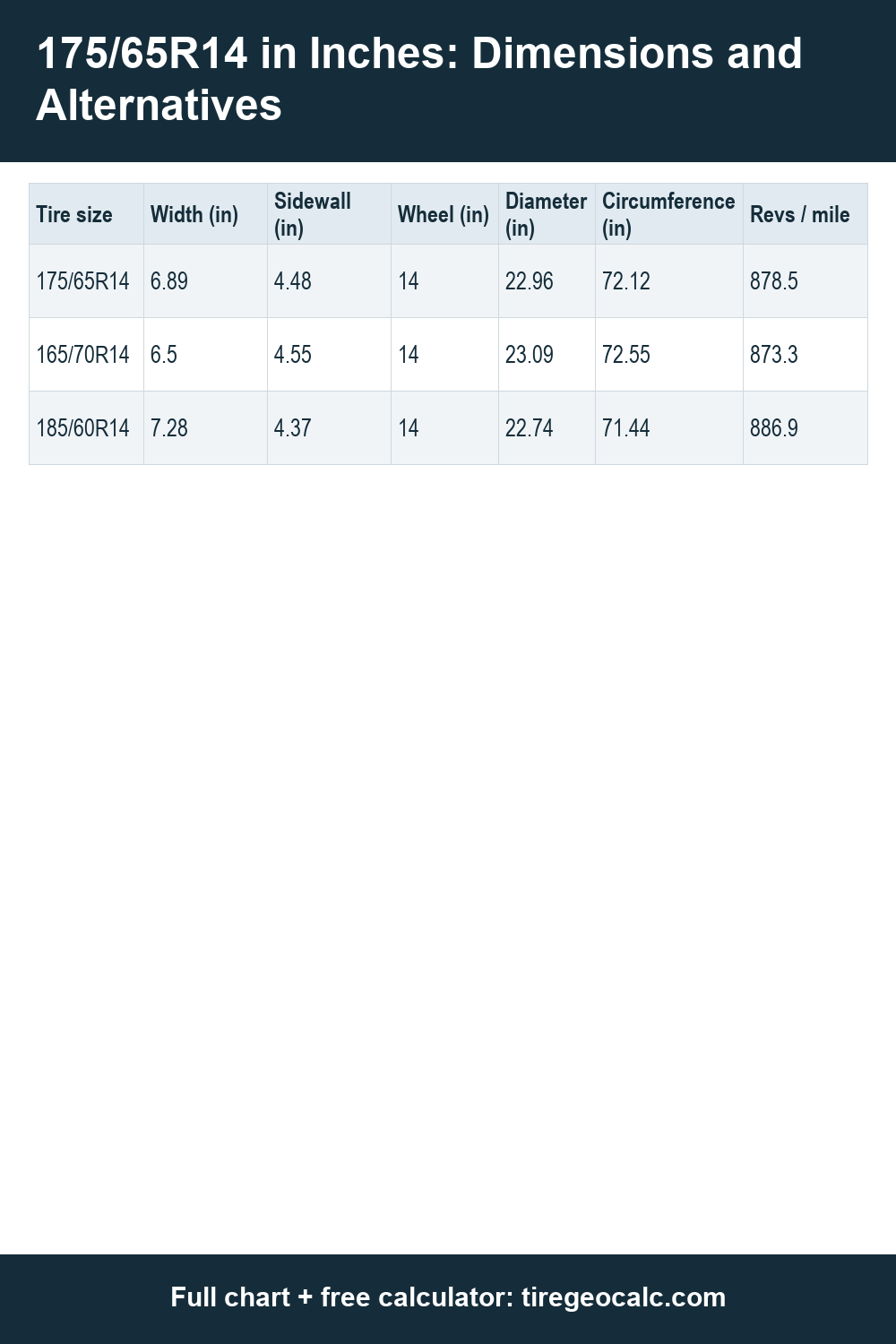
The first row, 175/65R14, is the original reference. All measurements are derived from the tire geometry engine. Percentages and theoretical speed values keep that same original throughout; rounding is for display only.
| Tire size | Width (mm) | Width (in) | Sidewall (mm) | Sidewall (in) | Wheel (mm) | Wheel (in) | Diameter (mm) | Diameter (in) | Circumference (mm) | Circumference (in) | Revolutions / mile | Revolutions / km | Diameter change (%) |
|---|---|---|---|---|---|---|---|---|---|---|---|---|---|
| 175/65R14 | 175 | 6.89 | 113.8 | 4.48 | 355.6 | 14 | 583.1 | 22.96 | 1831.9 | 72.12 | 878.5 | 545.9 | 0 |
| 165/70R14 | 165 | 6.5 | 115.5 | 4.55 | 355.6 | 14 | 586.6 | 23.09 | 1842.9 | 72.55 | 873.3 | 542.6 | 0.6 |
| 185/60R14 | 185 | 7.28 | 111 | 4.37 | 355.6 | 14 | 577.6 | 22.74 | 1814.6 | 71.44 | 886.9 | 551.1 | -0.94 |
Nominal size-code geometry. Reference: 175/65R14. Display rounding only; not fitment approval.
- Tire size
- 175/65R14
- Width (mm)
- 175
- Width (in)
- 6.89
- Sidewall (mm)
- 113.8
- Sidewall (in)
- 4.48
- Wheel (mm)
- 355.6
- Wheel (in)
- 14
- Diameter (mm)
- 583.1
- Diameter (in)
- 22.96
- Circumference (mm)
- 1831.9
- Circumference (in)
- 72.12
- Revolutions / mile
- 878.5
- Revolutions / km
- 545.9
- Diameter change (%)
- 0
- Tire size
- 165/70R14
- Width (mm)
- 165
- Width (in)
- 6.5
- Sidewall (mm)
- 115.5
- Sidewall (in)
- 4.55
- Wheel (mm)
- 355.6
- Wheel (in)
- 14
- Diameter (mm)
- 586.6
- Diameter (in)
- 23.09
- Circumference (mm)
- 1842.9
- Circumference (in)
- 72.55
- Revolutions / mile
- 873.3
- Revolutions / km
- 542.6
- Diameter change (%)
- 0.6
- Tire size
- 185/60R14
- Width (mm)
- 185
- Width (in)
- 7.28
- Sidewall (mm)
- 111
- Sidewall (in)
- 4.37
- Wheel (mm)
- 355.6
- Wheel (in)
- 14
- Diameter (mm)
- 577.6
- Diameter (in)
- 22.74
- Circumference (mm)
- 1814.6
- Circumference (in)
- 71.44
- Revolutions / mile
- 886.9
- Revolutions / km
- 551.1
- Diameter change (%)
- -0.94
Older small cars and fourteen inch wheel references
An older vehicle may arrive with wheels or tires changed during its life. The installed size is therefore evidence of what is present, not proof of what the manufacturer specified. Read the placard and manual where available, and keep the original specification separate from the current equipment. This matters before calculating a speed change or selecting a replacement.
The nearby 165/70R14 narrows the nominal section while increasing its percentage height. The 185/60R14 example widens the section and lowers that percentage. Holding the wheel at fourteen inches makes the sidewall trade easy to follow. Compare the calculated total heights instead of assuming the ratio changes create exact matches.
Dimensions behind this particular shape
Read 175/65R14 from the outside circle inward: a 22.96 inch calculated diameter contains a 14 inch bead seat and two 4.48 inch sidewalls. The section converts to 6.89 inches across, while each sidewall is only 65% of the original 175 mm width. This explains why the last number identifies the wheel rather than the complete height. In millimeters the same assembly adds 227.50 of sidewall to 355.6 of wheel, totaling 583.10.
The older economy car reference combines 113.75 mm sidewalls with a fourteen inch wheel. Its nearby 165/70R14 uses 115.50 mm per side and reaches 586.60 mm, while 185/60R14 uses 111.00 mm and reaches 577.60 mm. Keeping 583.10 mm as the original outside height prevents a familiar small wheel number from becoming the entire specification. These dimensions are also independent of storage age or tread condition. If the comparison involves a wheel set taken from a garage, retain its identification and inspection findings alongside the metric codes; the formula cannot evaluate whether the actual rubber remains serviceable.
Research the actual wheel and tire
A search involving old stored tires also needs an assessment unrelated to size. This conversion does not inspect age, damage, repair history or condition. Nor does it establish that an old wheel is suitable for continued use. Keep condition questions with the actual items and use the chart only for nominal geometry. A matching code is a starting identifier rather than a complete statement of usability.
Frequently asked questions
Can I select a fresh tire by its fourteen inch wheel size alone?
175/65R14 is commonly found in older economy car and small hatchback applications. Fourteen inches describes only the center wheel diameter, leaving the section and sidewall unresolved. When replacing a stored or aged assembly, obtain the full marking and inspect condition independently of the conversion. The nearby size rows cannot certify the serviceability of rubber or a wheel that has spent years in storage. Use the dimensions to identify proportions; use appropriate inspection and documentation to decide whether a particular physical assembly belongs back in service.
Why retain unrounded values when calculating travel for 175/65R14?
The displayed 22.96 inch height is rounded, while the geometric circumference uses the full 583.10 mm diameter. That yields 72.12 inches per turn and 878.53 revolutions per mile. Recalculating from a rounded cell can differ slightly; keep the definition and precision clear when comparing the result with another dimension source.
Does a matching conversion establish that a stored wheel set is serviceable?
Condition is independent of the fourteen inch geometric conversion. A stored tire may retain its original marking while its physical condition changes, and the wheel also needs assessment. Retain identification and inspection findings rather than treating the small outside diameter or an old vehicle application as evidence that the assembly is ready to use.
Continue your comparison
These are nominal geometric calculations, not vehicle fitment approval. Check the vehicle manual and exact tire and wheel specifications, including load and speed ratings, approved rim width and clearance; consult the manual for any diameter change exceeding 3%.
Reference tables: Load index chart and Speed rating chart.