 TireGeoCalc
35x12.50R20 vs 295/55R20: Tire Size Comparison
Quick answer
Nominal geometry35X12.50R20 → 295/55R20 · original-size calibration assumed
- Diameter difference
- -2.22in
- Diameter change
- -6.36%
- Actual at indicated 60 mph
- 56.19mph
Calculated from size markings. Not measured rolling dimensions or vehicle fitment approval.
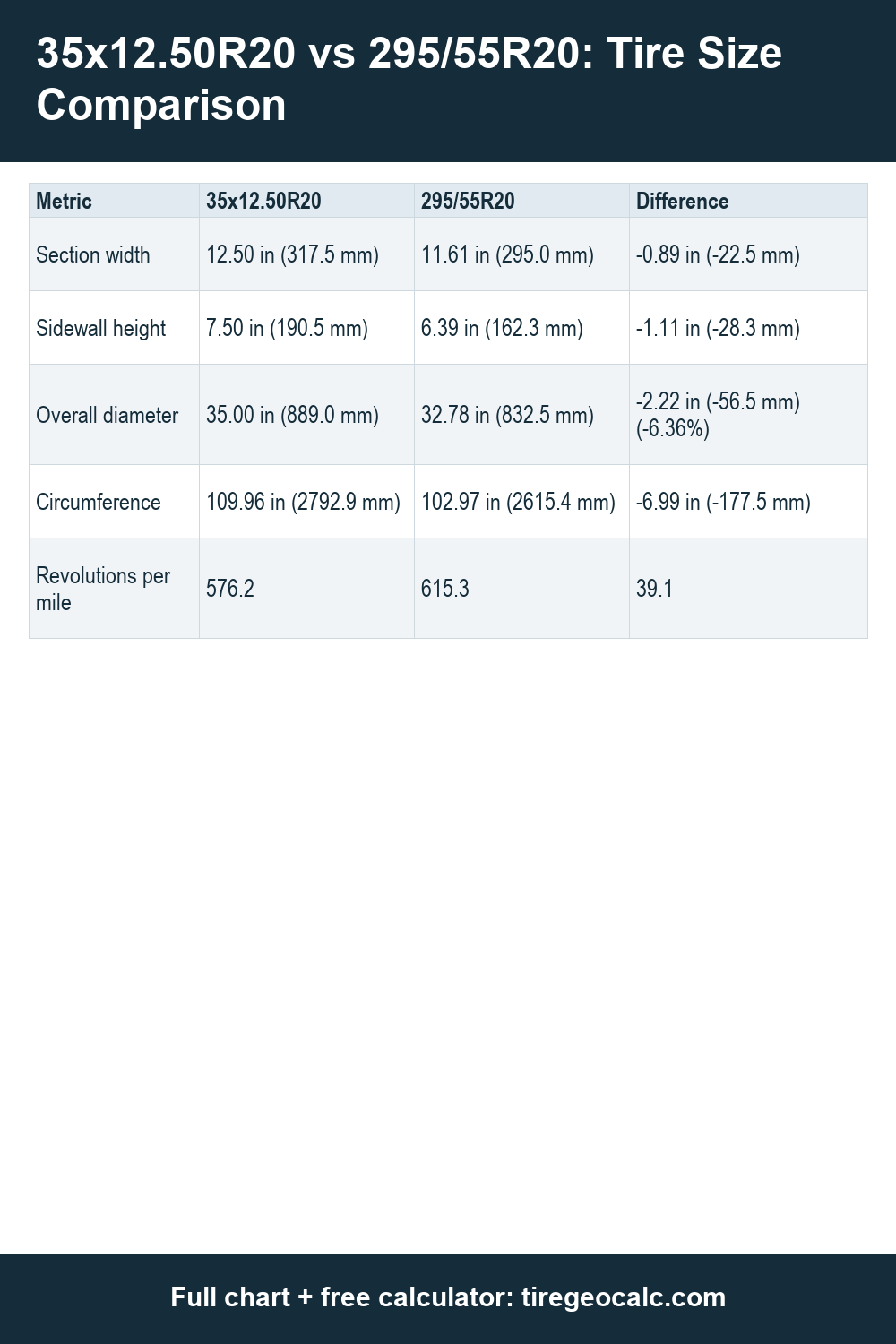
35x12.50R20 has a nominal diameter of 35.00 in (889.0 mm), while 295/55R20 is 32.78 in (832.5 mm). Moving from the first size to the second changes diameter by -6.36%. These are nominal geometric calculations, not vehicle fitment approval. Check the vehicle manual and exact tire and wheel specifications, including load and speed ratings, approved rim width and clearance; consult the manual for any diameter change exceeding 3%.
| Metric | 35x12.50R20 | 295/55R20 | Difference |
|---|---|---|---|
| Section width | 12.50 in (317.5 mm) | 11.61 in (295.0 mm) | -0.89 in (-22.5 mm) |
| Sidewall height | 7.50 in (190.5 mm) | 6.39 in (162.3 mm) | -1.11 in (-28.3 mm) |
| Overall diameter | 35.00 in (889.0 mm) | 32.78 in (832.5 mm) | -2.22 in (-56.5 mm) (-6.36%) |
| Circumference | 109.96 in (2792.9 mm) | 102.97 in (2615.4 mm) | -6.99 in (-177.5 mm) |
| Revolutions per mile | 576.2 | 615.3 | 39.1 |
Calculated dimensions
- Metric
- Section width
- 35x12.50R20
- 12.50 in (317.5 mm)
- 295/55R20
- 11.61 in (295.0 mm)
- Difference
- -0.89 in (-22.5 mm)
- Metric
- Sidewall height
- 35x12.50R20
- 7.50 in (190.5 mm)
- 295/55R20
- 6.39 in (162.3 mm)
- Difference
- -1.11 in (-28.3 mm)
- Metric
- Overall diameter
- 35x12.50R20
- 35.00 in (889.0 mm)
- 295/55R20
- 32.78 in (832.5 mm)
- Difference
- -2.22 in (-56.5 mm) (-6.36%)
- Metric
- Circumference
- 35x12.50R20
- 109.96 in (2792.9 mm)
- 295/55R20
- 102.97 in (2615.4 mm)
- Difference
- -6.99 in (-177.5 mm)
- Metric
- Revolutions per mile
- 35x12.50R20
- 576.2
- 295/55R20
- 615.3
- Difference
- 39.1
Speedometer effect: first size to second size
The reference calibration is 35x12.50R20; the replacement is 295/55R20. Differences always mean replacement minus original. The nominal speed change is -6.36%. With the original calibration retained, the speedometer would over-read after this change. Actual speed equals indicated speed multiplied by replacement diameter divided by original diameter.
| Indicated speed | Calculated actual speed | Actual minus indicated |
|---|---|---|
| 30 mph | 28.09 mph | -1.91 mph |
| 60 mph | 56.19 mph | -3.81 mph |
Calculated dimensions
- Indicated speed
- 30 mph
- Calculated actual speed
- 28.09 mph
- Actual minus indicated
- -1.91 mph
- Indicated speed
- 60 mph
- Calculated actual speed
- 56.19 mph
- Actual minus indicated
- -3.81 mph
These are not equivalent tire sizes
35x12.50R20 and 295/55R20 are not equivalent: the flotation tire is nominally 35 inches tall, while the metric tire is approximately 32.8 inches. Both end in R20, but that only identifies wheel diameter. It does not describe the amount of tire above and below the wheel, or imply matching overall height.
In the flotation code, thirty-five is overall diameter and twelve-point-five is section width, both in inches. In the metric code, 295 is width in millimeters and fifty-five is sidewall height as a percentage of that width. Calculating both complete codes gives a diameter change of -6.36% toward 295/55R20. That is a substantial reduction rather than a rounding difference between naming systems.
Which metric candidates are closer to a 35-inch diameter?
A useful metric comparison must calculate height instead of choosing by wheel diameter or width alone. The following candidates share the 20-inch wheel diameter. Each difference below uses 35x12.50R20 as its reference. These are calculated dimensional candidates, not exact equivalents or vehicle-approved alternatives.
- 315/70R20: diameter 37.36 in (949.0 mm), section width 12.40 in (315.0 mm), diameter change +6.75% from 35x12.50R20.
- 325/60R20: diameter 35.35 in (898.0 mm), section width 12.80 in (325.0 mm), diameter change +1.01% from 35x12.50R20.
325/60R20 is closer in nominal diameter than 315/70R20 among these two examples. Neither reproduces both flotation dimensions exactly. The former is wider than the flotation reference, and the latter uses a different combination of section width and sidewall proportion. Availability, approved rim width and the exact tire's load and speed specifications must be checked separately before selecting a product.
Why the shorter candidate changes the speed reading
With the 35-inch tire treated as original, the shorter metric replacement travels less distance per theoretical wheel revolution. It therefore needs more revolutions to cover a mile. A speedometer still calibrated for the original would display a greater speed than this nominal calculation predicts as actual. Read the thirty- and sixty-mile-per-hour rows with that original-to-replacement direction in mind.
The diameter reduction also lowers theoretical axle height by 1.11 in (28.3 mm) on an ideal rigid circle. Loaded tire deflection and vehicle geometry make actual clearance a separate question. A shorter outside diameter does not prove clearance beside suspension parts, and a matching wheel diameter does not establish wheel width, offset or load capacity.
Frequently asked questions
Is 295/55R20 a metric version of 35x12.50R20?
No. The metric tire's approximate 32.8-inch diameter is clearly below the flotation label's thirty-five inches. Compare the overall-diameter and circumference rows rather than relying on the shared R20 ending. They are different heights as well as different nominal section widths.
Is 325/60R20 an exact equivalent?
No. It is a closer calculated diameter candidate among the examples shown here, but still has a different nominal width and a small diameter difference. An actual product's published dimensions and mounting specifications can differ from the ideal size-code geometry. Similar diameter does not establish interchangeability.
Why does 315/70R20 come out taller than thirty-five inches?
Its seventy-percent sidewall acts on its metric width, and two sidewalls are added to the wheel diameter. This combination produces the calculated height listed above. A code that looks plausible as a conversion still needs the complete calculation; wheel size and section width alone leave height undetermined.
Does recalibrating the speedometer approve the change?
No. Calibration addresses the instrument relationship, while vehicle requirements, axle loads, speed rating, rim width and clearance require their own checks. Consult the vehicle manual for this diameter change. This page cannot authorize changes to suspension, brakes, payload or the manufacturer's tire recommendations.
For the arithmetic behind the two naming systems, read how to convert flotation tire sizes to metric. Compare any candidate using its full code rather than substituting an approximate inch label.
Sources and limits
All dimensions and speeds here come from this site's tire engine using the complete size codes, with rounding only for display. Circumference uses an ideal circle; revolutions per mile use that circumference. These are not manufacturer-measured rolling dimensions. For your own inputs, open the tire size calculator. Read the full disclaimer before making a replacement decision.
These are nominal geometric calculations, not vehicle fitment approval. Check the vehicle manual and exact tire and wheel specifications, including load and speed ratings, approved rim width and clearance; consult the manual for any diameter change exceeding 3%.
Reference tables: Load index chart and Speed rating chart.