 TireGeoCalc
265/70R18 vs 285/70R17: Tire Size Comparison
Quick answer
Nominal geometry265/70R18 → 285/70R17 · original-size calibration assumed
- Diameter difference
- +0.10in
- Diameter change
- +0.31%
- Actual at indicated 60 mph
- 60.19mph
Calculated from size markings. Not measured rolling dimensions or vehicle fitment approval.
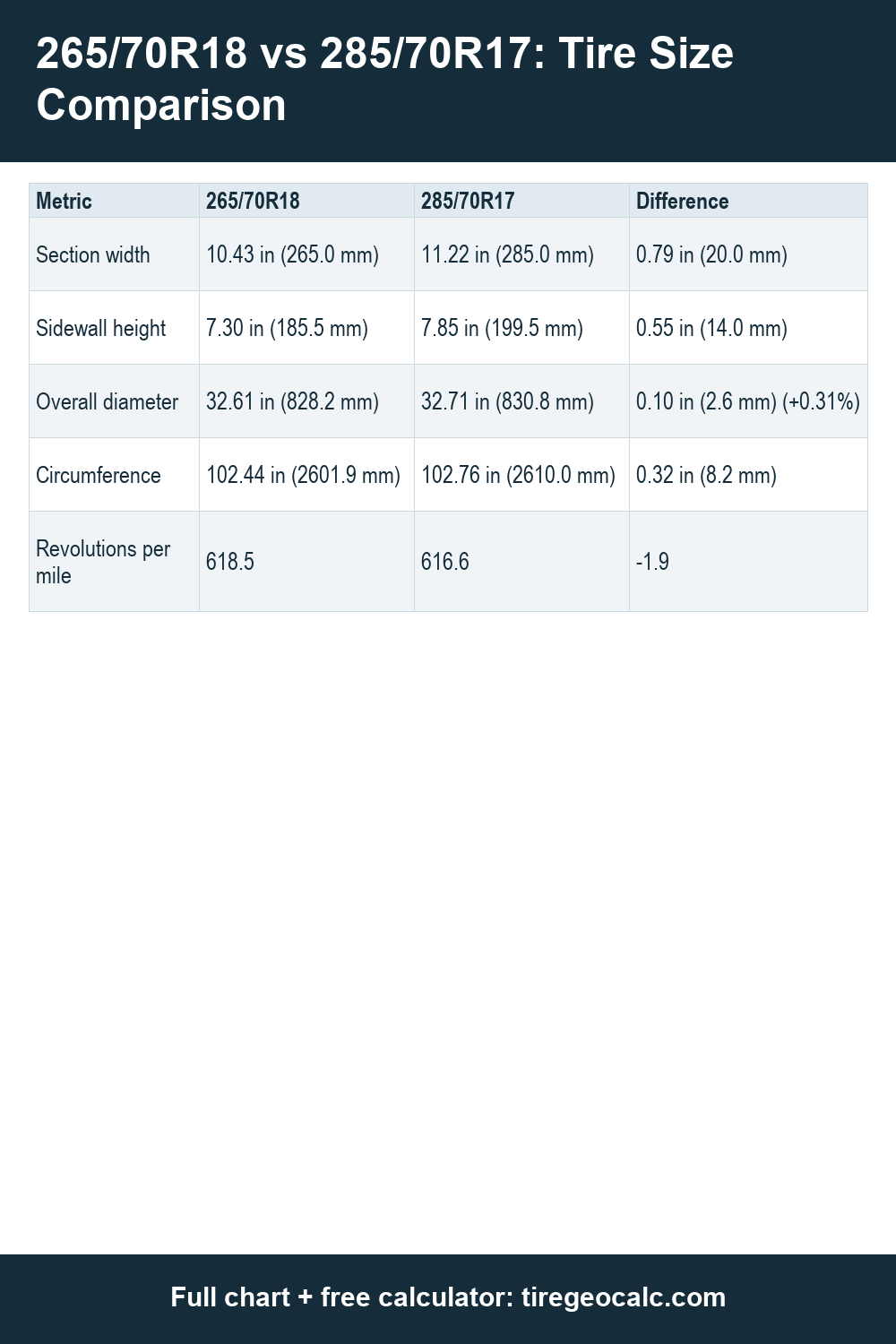
265/70R18 has a nominal diameter of 32.61 in (828.2 mm), while 285/70R17 is 32.71 in (830.8 mm). Moving from the first size to the second changes diameter by +0.31%. These are nominal geometric calculations, not vehicle fitment approval. Check the vehicle manual and exact tire and wheel specifications, including load and speed ratings, approved rim width and clearance; consult the manual for any diameter change exceeding 3%.
| Metric | 265/70R18 | 285/70R17 | Difference |
|---|---|---|---|
| Section width | 10.43 in (265.0 mm) | 11.22 in (285.0 mm) | 0.79 in (20.0 mm) |
| Sidewall height | 7.30 in (185.5 mm) | 7.85 in (199.5 mm) | 0.55 in (14.0 mm) |
| Overall diameter | 32.61 in (828.2 mm) | 32.71 in (830.8 mm) | 0.10 in (2.6 mm) (+0.31%) |
| Circumference | 102.44 in (2601.9 mm) | 102.76 in (2610.0 mm) | 0.32 in (8.2 mm) |
| Revolutions per mile | 618.5 | 616.6 | -1.9 |
Calculated dimensions
- Metric
- Section width
- 265/70R18
- 10.43 in (265.0 mm)
- 285/70R17
- 11.22 in (285.0 mm)
- Difference
- 0.79 in (20.0 mm)
- Metric
- Sidewall height
- 265/70R18
- 7.30 in (185.5 mm)
- 285/70R17
- 7.85 in (199.5 mm)
- Difference
- 0.55 in (14.0 mm)
- Metric
- Overall diameter
- 265/70R18
- 32.61 in (828.2 mm)
- 285/70R17
- 32.71 in (830.8 mm)
- Difference
- 0.10 in (2.6 mm) (+0.31%)
- Metric
- Circumference
- 265/70R18
- 102.44 in (2601.9 mm)
- 285/70R17
- 102.76 in (2610.0 mm)
- Difference
- 0.32 in (8.2 mm)
- Metric
- Revolutions per mile
- 265/70R18
- 618.5
- 285/70R17
- 616.6
- Difference
- -1.9
Speedometer effect: first size to second size
The reference calibration is 265/70R18; the replacement is 285/70R17. Differences always mean replacement minus original. The nominal speed change is +0.31%. With the original calibration retained, the speedometer would under-read after this change. Actual speed equals indicated speed multiplied by replacement diameter divided by original diameter.
| Indicated speed | Calculated actual speed | Actual minus indicated |
|---|---|---|
| 30 mph | 30.09 mph | +0.09 mph |
| 60 mph | 60.19 mph | +0.19 mph |
Calculated dimensions
- Indicated speed
- 30 mph
- Calculated actual speed
- 30.09 mph
- Actual minus indicated
- +0.09 mph
- Indicated speed
- 60 mph
- Calculated actual speed
- 60.19 mph
- Actual minus indicated
- +0.19 mph
Different wheels, almost the same overall height
This pair separates wheel diameter from tire diameter. The 265/70R18 code calls for an 18-inch bead seat, while 285/70R17 calls for a 17-inch bead seat. Neither tire can be mounted on the other wheel diameter. Comparing these codes therefore describes a tire-and-wheel change, rather than two tires for a single existing wheel. The overall height can remain close even when the wheel itself becomes smaller.
Both aspect ratios are seventy, but that percentage is applied to different section widths. The wider metric tire consequently has a taller sidewall. Two taller sidewalls almost offset the smaller wheel diameter. The remaining diameter difference is 0.10 in (2.6 mm). This is why choosing by the final wheel number alone can produce the wrong conclusion about speedometer correction or tire height.
What the width change adds to the decision
The section-width increase is 0.79 in (20.0 mm). That nominal increase is separate from the very small diameter change. A similar outside height does not mean the tire occupies the same lateral space. Wheel width and offset influence the position of the inner and outer sidewalls, and actual tire width depends on the measuring rim used by the manufacturer.
For a wheel change, check the complete wheel specification as well as the tire code. A smaller bead-seat diameter may affect space around the brakes. Mounting pattern, center bore, load capacity and mounting hardware are independent requirements. None can be calculated from nominal tire diameter. Obtain vehicle-specific wheel guidance before treating this geometric pair as a practical replacement plan.
How to read the small speed difference
The replacement in this direction is slightly taller, so it covers slightly more distance per theoretical revolution. Its calculated revolutions per mile are correspondingly lower. The speed table assumes calibration for the first size and no other instrument error. A previously recalibrated vehicle needs its current calibration identified before applying a correction, even when the nominal difference is small.
Diameter also affects the theoretical axle height above level ground by half the diameter change, before tire deflection. That calculation does not establish usable ground clearance under load or clearance during suspension movement. Compare actual product specifications, inflation guidance and vehicle measurements. The decimals in this table express arithmetic precision, rather than a promise about the loaded tire's shape.
Frequently asked questions
Can 285/70R17 go on my existing 18-inch wheels?
No. Its R17 marking requires a 17-inch bead-seat diameter. Keeping almost the same overall height does not make a 17-inch tire mountable on an 18-inch wheel. A complete wheel change requires separate checks for the vehicle and the exact wheel.
Why is the tire on the smaller wheel slightly taller?
The seventy-percent sidewall calculation uses a wider nominal section for 285/70R17. The gain across both sidewalls slightly exceeds the reduction in wheel diameter. Read the sidewall and overall-diameter rows together; the wheel size by itself cannot determine the result.
Will the larger sidewall guarantee a softer ride?
No. Sidewall height is one geometric input, while construction, load, pressure and the chosen tire model also matter. This page has no measured ride-comfort data. Use the calculated dimensions to frame the comparison and the actual product specifications to assess the intended application.
Is a close diameter enough for an approved replacement?
No. Verify load index, speed rating, rim width, clearance and vehicle guidance. If changing between passenger and LT construction, check the appropriate load and pressure information too. Neither the nominal width nor the diameter comparison establishes carrying capacity or approval for a particular axle.
Compare 265/70R17 with 285/70R17 to isolate a width change on equal wheel diameters. For the wheel-change method, read what tire size you need for bigger wheels.
Sources and limits
All dimensions and speeds here come from this site's tire engine using the complete size codes, with rounding only for display. Circumference uses an ideal circle; revolutions per mile use that circumference. These are not manufacturer-measured rolling dimensions. For your own inputs, open the tire size calculator. Read the full disclaimer before making a replacement decision.
These are nominal geometric calculations, not vehicle fitment approval. Check the vehicle manual and exact tire and wheel specifications, including load and speed ratings, approved rim width and clearance; consult the manual for any diameter change exceeding 3%.
Reference tables: Load index chart and Speed rating chart.