TireGeoCalc
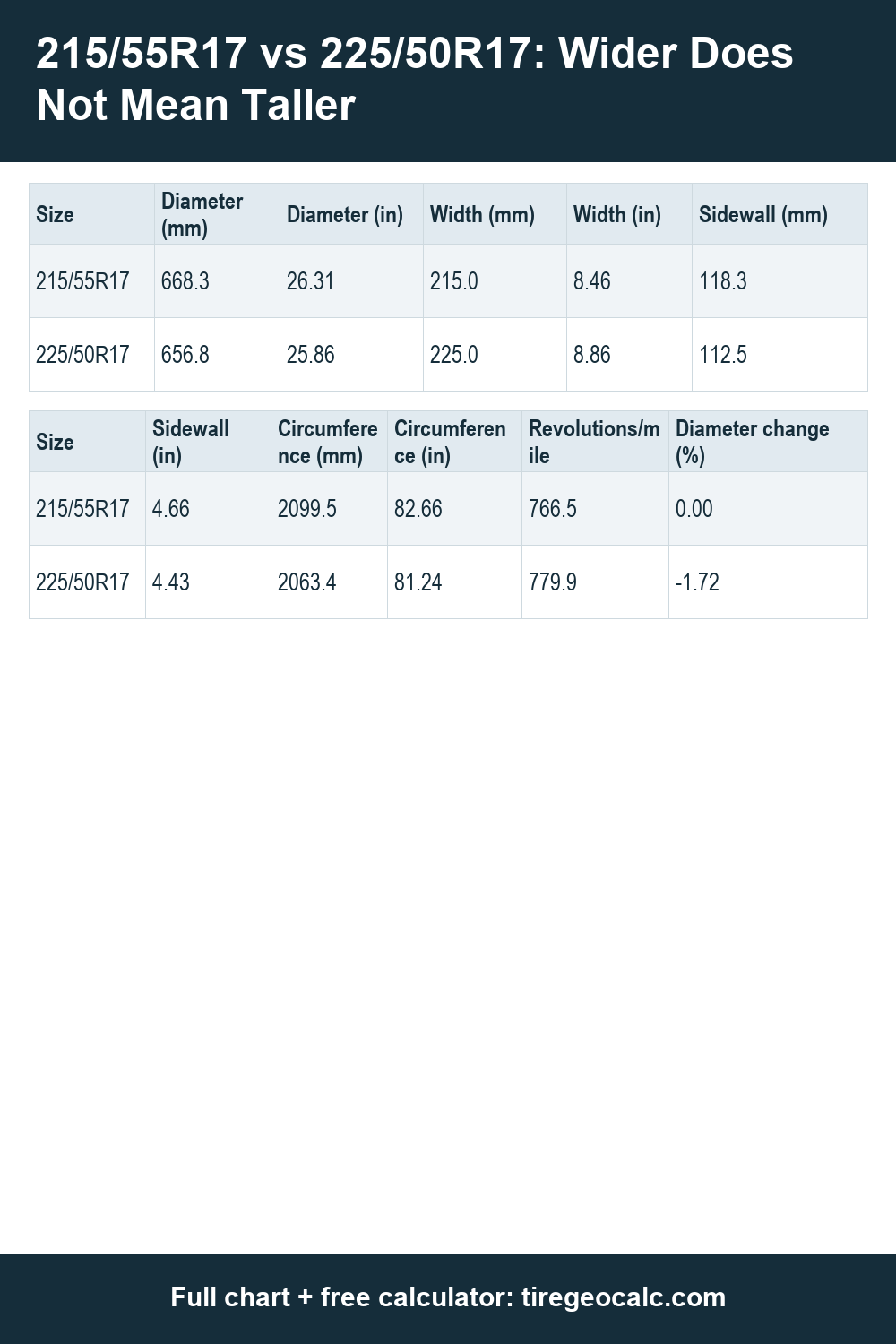
It is easy to assume that a wider tire is also a bigger tire. This page shows with real numbers that this is not always true. We compare 215/55R17 with 225/50R17. The second tire is 10 mm wider, yet it is shorter overall, because its aspect ratio drops from 55 to 50. Both sizes fit a 17 inch wheel, so the only things that move are the width and the sidewall. Below you will see the nominal width, sidewall, diameter, circumference and revolutions for each size, a worked speedometer example, and the limits of what this kind of math can tell you. The 215/55R17 size is the starting point for every comparison, and all values come from the table on this page.
Read these exact size markings
In 215/55R17 the width is 215 mm, the aspect ratio is 55 and the wheel is 17 inches. In 225/50R17 the width is 225 mm, the aspect ratio is 50 and the wheel is again 17 inches. The ratio is the sidewall height as a percentage of the width. That is why width alone never tells you the height.
The table shows how this plays out. The 215/55R17 sidewall is 118.3 mm. The 225/50R17 sidewall is 112.5 mm. The wider tire has the lower sidewall, because 50 percent of 225 mm is less than 55 percent of 215 mm. Both use the same 431.8 mm rim, so the wheel part of the height is identical.
Work through this page's numerical example
Start with 215/55R17. Its width is 215 mm and its overall diameter is 668.3 mm, which is 26.31 inches. Its circumference is 2099.5 mm, or 82.66 inches, and it turns 766.5 times per mile and 476.3 times per kilometer.
Now 225/50R17. Its width is 225 mm and its overall diameter is 656.8 mm, which is 25.86 inches. Its circumference is 2063.4 mm, or 81.24 inches, and it turns 779.9 times per mile and 484.6 times per kilometer. The table lists the diameter change as minus 1.72 percent from the 215/55R17 baseline. The minus sign tells you the wider tire is the shorter one, so it needs more turns to cover a mile.
Explain the practical geometry difference
Picture the tire as a stack again. The overall diameter equals the rim plus a sidewall on each side. Since the rim is the same in both sizes, any difference in total height has to come from the sidewalls. A lower ratio makes a lower sidewall, and a lower sidewall on both sides makes a lower tire.
Width does not enter the height stack at all. It only decides how wide the tire is across the tread, and it feeds into the sidewall through the ratio. In this pair the extra 10 mm of width adds a little to the sidewall, but dropping the ratio from 55 to 50 takes away more than that. The net result is a shorter tire that is wider at the same time.
See what the speedometer would read
A shorter tire covers less ground per turn. If your speedometer was set for 215/55R17, the real speed with 225/50R17 is a little lower than the dial shows. When the dial reads 30 mph, the real speed is 29.5 mph. When it reads 60 mph, the real speed is 59 mph. When it reads 75 mph, the real speed is 73.7 mph.
These values assume the original calibration matches the 215/55R17 size. If it does not, the starting point changes and so do the results. Remember too that these are calculated from nominal geometry, so they describe the direction and rough size of the change and do not report a measurement from any vehicle.
Understand nominal dimensions and rounding
All values here are nominal. They come from the size marking and from plain geometry, not from a tire carrying a load. In real use a tire flexes, wears and varies from brand to brand, so a measured rolling circumference can differ from the nominal one.
Rounding is applied only when numbers are shown. The sidewall of 118.25 mm is displayed as 118.3 mm, for example. The full precision stays inside the calculation. Working by hand with the rounded numbers can land you a small step away from the table, and that is just a rounding effect.
Check what the calculation cannot decide
A similar diameter is not approval for your vehicle. This page does not tell you whether a size will mount on your wheel, clear the suspension and body, or fit the maker's list of allowed sizes. It also does not tell you anything about pressure, load capacity, comfort or fuel use.
Use the table to understand why a wider tire can be shorter. Then check the vehicle placard, the owner manual and a qualified tire professional before you decide anything. The numbers answer a geometry question and nothing beyond it.